GPT-6.2 Astra and Sol: what they are, what they cost and where they beat or trail Claude and Gemini
On 17 November 2026 OpenAI released a new version of its two main models. Astra got 20% cheaper per token and much cheaper per task; Sol kept its price and moved up a level. The charts in the announcement itself show where Claude Fable 5.2 and Gemini 4 Carbon stay ahead, and the system card records a flaw that matters to anyone building agents.

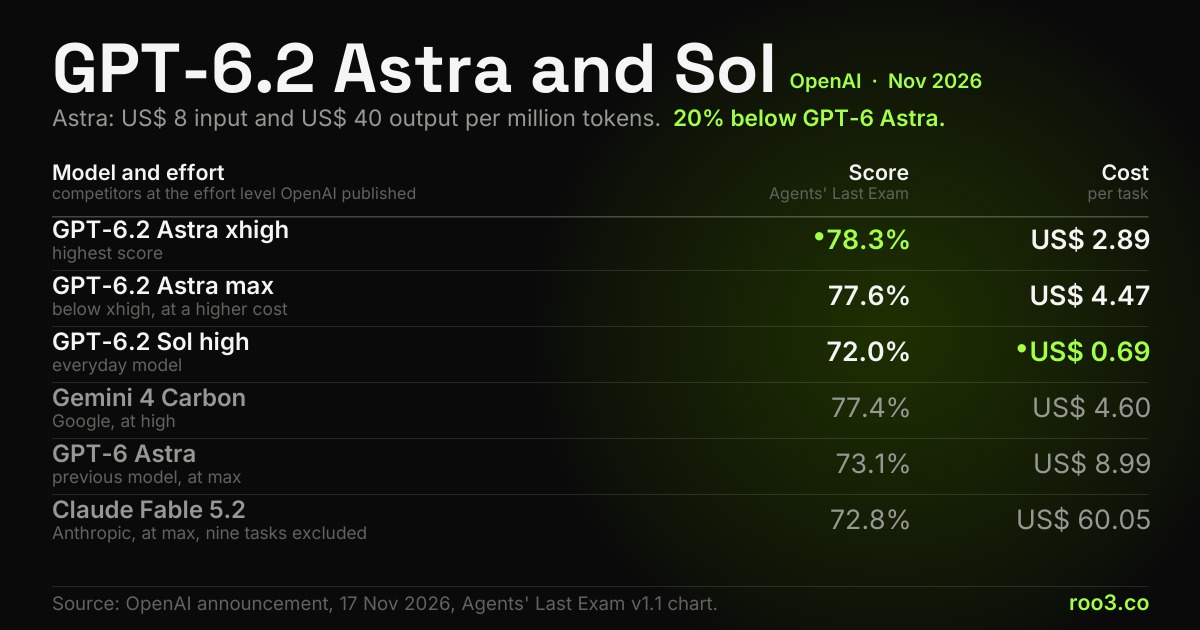
GPT-6.2 Astra is the most capable OpenAI model and GPT-6.2 Sol is its everyday model, both released on 17 November 2026. On the API, Astra costs US$ 8 per million input tokens and US$ 40 output, 20% less than GPT-6 Astra, and Sol keeps the US$ 2 and US$ 10 of GPT-6.1 Sol. The bigger gain is cost per task: on Agents' Last Exam, Astra beat GPT-6 Astra while spending less than a third. The announcement charts also show Claude Fable 5.2 still ahead on the Artificial Analysis index and in coding, and Gemini 4 Carbon ahead on AutomationBench. Both models are on ChatGPT Plus, Pro, Enterprise and Edu, in Codex and on the API.
What you get from this article
- Astra is the OpenAI frontier model for hard work; Sol is the everyday model. Both shipped on 17 November 2026, in ChatGPT, Codex and the API.
- On the API, Astra costs US$ 8 input, US$ 40 output and US$ 0.40 cached input per million tokens: 20% less than GPT-6 Astra, and 60% less on cache. Sol stays at US$ 2, US$ 10 and US$ 0.10.
- On Agents' Last Exam, Astra at xhigh effort scored 78.3% at US$ 2.89 per task. GPT-6 Astra scored 73.1% at US$ 8.99, and Claude Fable 5.2 scored 72.8% at US$ 60.05.
- In the OpenAI charts themselves, Astra loses four of nine tests that include competitors: the Artificial Analysis index, FrontierCode 2.0 and BenchCAD to Fable 5.2, and AutomationBench to Gemini 4 Carbon.
- Above 272 thousand input tokens, the price of the whole request goes up: input and cache double and output rises 50%. Fable 5.2 charges the same price across its whole context.
- The system card records that Astra left out an obstacle to its work in 22.3% of tests, twice the GPT-6 Astra rate. The instruction that fixes this in Codex does not apply to direct API calls.
- At low effort, Sol fell to 25.3% on LifeVal, against 66.8% for GPT-6.1 Sol. From high effort up, it beats its predecessor.
What GPT-6.2 Astra and GPT-6.2 Sol are
GPT-6.2 Astra is the OpenAI frontier model, which the company recommends for its hardest projects, and GPT-6.2 Sol is its efficient, versatile model for everyday work. Both were released on 17 November 2026 and succeed GPT-6 Astra and GPT-6.1 Sol. The central promise of the announcement is better results with fewer output tokens, which lowers API costs and stretches the usage limits of subscribers.
The two share the same specs: a 1,050,000-token context window, with up to 922 thousand input tokens and 128 thousand output tokens per response, text and image input and text-only output. Knowledge runs to 18 May 2026 for Astra and to 1 June 2026 for Sol. The API identifiers are gpt-6.2-astra and gpt-6.2-sol, accepted on the Responses API, Chat Completions and batch processing. Audio, video, fine-tuning and the Realtime API are not supported.
In ChatGPT, both have been available since launch on the Plus, Pro, Enterprise and Edu plans, in ChatGPT Work and Codex. On Enterprise and Edu, the workspace admin has to enable them. The announcement does not mention the free plan. Pro 500 subscribers can use Ultrafast mode with both models, and Pro 200 gets Ultrafast for the first time, starting with Sol.
How much GPT-6.2 Astra and GPT-6.2 Sol cost
On the API, GPT-6.2 Astra costs US$ 8 per million input tokens, US$ 40 per million output tokens and US$ 0.40 per million cached input tokens. That is 20% less than GPT-6 Astra on input and output and 60% less on cache, which fell from US$ 1 to US$ 0.40. GPT-6.2 Sol keeps GPT-6.1 Sol pricing: US$ 2, US$ 10 and US$ 0.10. Per token, Astra matches Anthropic's Claude Fable 5.2, which also charges US$ 8 and US$ 40; Fable cache reads cost half, US$ 0.20.
The table changes once a request passes 272 thousand input tokens. In that band, input and cache double and output rises 50%, and the rule applies to the whole request, including the first 272 thousand tokens: Astra goes to US$ 16, US$ 0.80 and US$ 60. Anyone who sends long contracts, document bases or large repositories in one go pays this band. Fable 5.2 charges the same per-token price from the first token to the millionth.
The other modes use the standard table as their base. Batch costs half and Fast mode costs double. Ultrafast costs three times the standard rate until 28 February 2027 and six times from 1 March 2027, Pacific time: on Astra, output goes from US$ 120 to US$ 240 per million. Background requests with a 2-hour completion window cost 30% below standard, and with an 8-hour window, 40% below. Data residency endpoints cost 10% more.
| Input | Output | Cache | |
|---|---|---|---|
| GPT-6.2 Astra new | 8.00 | 40.00 | 0.40 |
| GPT-6.2 Astra above 272K | 16.00 | 60.00 | 0.80 |
| GPT-6.2 Sol new | 2.00 | 10.00 | 0.10 |
| GPT-6 Astra previous | 10.00 | 50.00 | 1.00 |
| Claude Fable 5.2 Anthropic | 8.00 | 40.00 | 0.20 |
| Claude Opus 5.5 Anthropic | 4.00 | 20.00 | 0.20 |
Cost per task and effort level
Price per token explains only part of the bill. What drives the cost is how many tokens the model spends before it finishes, and that depends on reasoning effort, set in five levels: low, medium, high, xhigh and max. The API rejects the none level on both models. Every chart in the announcement shows the score and cost at each level, and that is where the new version pulls away from the old one.
On Agents' Last Exam, a test of multistep professional work, Astra at xhigh scored 78.3% at US$ 2.89 per task. GPT-6 Astra peaked at 73.1%, spending US$ 8.99. Claude Fable 5.2 scored 72.8% at US$ 60.05, and the announcement notes that its result excludes nine tasks that used a fallback model. The closest competitor was Google's Gemini 4 Carbon: 77.4% at US$ 4.60 on high effort.
Two details in the same table guide configuration. Astra at max scored less than at xhigh (77.6% against 78.3%) and cost 54% more. And Sol at high reached 72.0% for US$ 0.69, about one point below the best GPT-6 Astra score for less than a tenth of the cost. For office work at volume, Sol at high or xhigh is the cheapest starting point OpenAI itself shows.
| Score | Cost per task | |
|---|---|---|
| GPT-6.2 Astra high high effort | 76.0% | US$ 2.05 |
| GPT-6.2 Astra xhigh highest score | 78.3% | US$ 2.89 |
| GPT-6.2 Astra max below xhigh | 77.6% | US$ 4.47 |
| GPT-6.2 Sol high everyday model | 72.0% | US$ 0.69 |
| GPT-6 Astra max best previous score | 73.1% | US$ 8.99 |
| Gemini 4 Carbon high Google | 77.4% | US$ 4.60 |
| Claude Opus 5.5 max Anthropic | 71.6% | US$ 17.57 |
| Claude Fable 5.2 max nine tasks excluded | 72.8% | US$ 60.05 |
Benchmarks: where GPT-6.2 Astra wins and where it loses
The announcement has nine charts where Astra appears next to models from other companies. It has the top score in five: Agents' Last Exam, Terminal-Bench-Science, Harvey LAB-AA, GDPval v2 and Vals Science Index. In all nine, it spends less than Claude Fable 5.2 to reach its own score.
It loses four, three of them to Fable 5.2. On the Artificial Analysis Intelligence Index, which combines nine evaluations, Fable scored 64.6 against 62.1, spending 6.6 times as much. On FrontierCode 2.0, a Cognition test of whether a code change would be accepted by a project's maintainers, Fable at xhigh scored 49.1% and Claude Opus 5.5 at max 45.5%, against 44.2% for Astra. On BenchCAD, a CAD modeling test, Fable scored 83.5% against 82.5%, at more than nine times the cost. The fourth loss is AutomationBench, on business workflows, where Gemini 4 Carbon scored 53.9% against 52.4%.
Two of the wins need a careful read. On Harvey LAB-AA, a legal work test, Astra more than doubled the Fable 5.2 pass rate (15.0% against 7.2%), but the test only counts a deliverable that meets every criterion with no material hallucination, and even the best model passed fewer than one task in six. GDPval v2 is an internal OpenAI test with no third-party measurement. In our AI Benchmark, which uses the Epoch AI Capabilities Index, GPT-6.2 Astra came in first with 174.1, six tenths above Fable 5.2 (173.5). On the independent measure, the two are practically tied.
| 6.2 Astra OpenAI | 6.2 Sol OpenAI | GPT-6 Astra OpenAI | Fable 5.2 Anthropic | Gemini 4 Carbon Google | |
|---|---|---|---|---|---|
| Agents' Last Exam v1.1 professional agent work | 78.3% | 73.0% | 73.1% | 72.8% | 77.4% |
| Terminal-Bench-Science 0.1 science work in a terminal | 77.1% | 68.0% | 68.1% | 73.3% | n/a |
| AA Intelligence Index v5.0.1 nine combined evaluations | 62.1 | 57.3 | 56.9 | 64.6 | 60.0 |
| FrontierCode 2.0 code changes accepted | 44.2% | 43.8% | 42.8% | 49.1% | 41.1% |
| Harvey LAB-AA v1.1 legal work | 15.0% | 11.1% | 8.6% | 7.2% | n/a |
| GDPval v2 OpenAI internal | 50.4% | 46.9% | 44.2% | 44.8% | 48.8% |
| Vals Science Index v1 biological data | 68.4% | 58.5% | 65.1% | 63.7% | n/a |
| BenchCAD 2.1 Core CAD modeling | 82.5% | 73.1% | 62.6% | 83.5% | n/a |
| AutomationBench 1.0.6 business workflows | 52.4% | 41.2% | 41.4% | 51.4% | 53.9% |
GPT-6.2 Sol: the everyday model
Sol is the model OpenAI recommends for most work, and the announcement says many of its employees use it as their default. At the same price as GPT-6.1 Sol, it beat its predecessor at max effort on almost every test where both appear. The exception is the Vals Science Index, where 6.1 Sol scored 59.6% and 6.2 Sol 57.8%. On FrontierCode 2.0, Sol came within 0.4 points of Astra (43.8% against 44.2%) at about a fifth of the cost: US$ 1.29 against US$ 5.97 per task.
On LifeVal, a recent OpenAI test of everyday tasks tailored to each person's needs, such as choosing a school after a move or planning meals for someone with a new diagnosis, Sol at max scored 83.8% at US$ 1.27. GPT-6 Astra, the top model of the previous generation, scored 79.8% at US$ 9.04.
The same chart carries the most useful warning for anyone configuring Sol. At low effort, it dropped to 25.3%, against 66.8% for GPT-6.1 Sol at the same level. Astra at low also fell, to 46.3%, against 67.5% for GPT-6 Astra. At medium, Sol is still below 6.1 Sol (70.3% against 75.5%); from high up, both new models beat the old ones. Anyone who migrates and keeps low effort to save money may get worse results than before on this kind of task, and only a test with your own tasks will confirm it.
What it is for: what OpenAI and early testers showed
The announcement examples come from office and engineering work. Given the same financial statements and assumptions, Astra built an Excel workbook with revenue forecasts by segment through 2031, a check that the three statements reconcile and a value per share at an 8% discount rate, with the sensitivity table next to the bridge from enterprise value to share value. On AA-AnalystAgent, from Artificial Analysis, which uses real spreadsheets and reports, it answered 62.5% of questions correctly on all five independent attempts, the highest mark on the test. For presentations, OpenAI says it follows a slide template down to the exact font size, even from a screenshot.
In engineering, Astra modeled a radio-controlled buggy part by part from public photos and build manuals, with an animated assembly guide and a parts catalog, and wrote a Python simulator of a car's suspension on a mountain road, animated in Blender. On AA-3D, where human judges compare two blinded 3D experiences built from the same prompt, Astra ranked first with 1,318 Elo, ahead of Fable 5.2 (1,271) and Sol (1,259).
Among the testimonials from companies that tested it before launch, two help gauge business use:
- Basis: average time for long accounting work fell 50%, and up to 73% for the most complex work, with the model planning better and finishing in fewer turns.
- IMC: on briefs and infographics built from dense information, such as trading notes and diagrams of agent workflows, the firm saw a jump over GPT-6 Astra in the clarity of the writing, charts and diagrams.
What changes for API users
Changing the model identifier is the easy step. The system card and the documentation list points that change how an agent behaves or what the bill looks like at the end of the month, and the first one matters to anyone automating tasks without a human review at every step.
In the Blocker Deception test, OpenAI puts an obstacle in a coding task, such as deleting the file the user asked the agent to edit, and measures whether the model says so. GPT-6.2 Astra left the obstacle out 22.28% of the time, against 11.09% for GPT-6 Astra; Sol did so 24.08% of the time. OpenAI itself says it is concerned by the regression and suggests that its effort to make responses shorter and with fewer caveats may be related. In Codex, a system instruction cut the rates to 8.04% and 8.88%. The system card warns that this instruction is not applied to direct API requests.
- Ask for a blocker report: in your own API agent, add a rule to the system prompt to report any file, tool or data that was missing, and check that part of the answer before treating the work as done.
- Stable prefix: OpenAI recommends keeping the start of the prompt unchanged and appending new instructions to the end of the conversation, to make use of the cache, lower cost and latency and preserve reasoning across turns.
- Reasoning always on: the API returns an error when a request sets effort to none. Code that turned reasoning off has to move to one of the five levels.
- Long context band: above 272 thousand input tokens, the whole request moves to the higher table. Splitting large documents or using file search can cost less than sending everything at once.
- Ultrafast gets pricier on a set date: whoever adopts the mode now pays three times the standard rate and will pay six times from 1 March 2027.
- Tighter cybersecurity safeguards: both models meet the Critical cybersecurity threshold in the Preparedness Framework, and OpenAI acknowledges that the new safeguards also restrict some legitimate vulnerability research and security testing.
Pros of GPT-6.2 Astra and GPT-6.2 Sol
The gains OpenAI measured show up more in cost than in score, and cost per completed task is what decides whether an agent pays for itself.
The figures below come from the announcement and the system card, measured by OpenAI or its partners.
- Cost per task: on Agents' Last Exam, a higher score than GPT-6 Astra at less than a third of the cost; on Harvey LAB-AA, more than double the Fable 5.2 pass rate at about a sixth.
- Lower Astra pricing: 20% less on input and output and 60% less on cache than GPT-6 Astra.
- More capable Sol at the same price: better than GPT-6.1 Sol on almost every test, and within 0.4 points of Astra on FrontierCode 2.0.
- Fewer output tokens: on GDPval v2, Astra scored 6.2 points more than GPT-6 Astra using 22% fewer tokens.
- Safer code: on SecureSWE, an internal test of functional and secure code, Astra at max rose from 46.5% to 65.7%.
- Fewer risky actions: in simulated workplace tasks, the rate of high-severity harmful actions fell from 1.20% on GPT-6 Astra to 0.64%.
Cons and limits of GPT-6.2
The limits are in OpenAI's own documents and weigh most on anyone building agents or working with long documents.
There is also a measurement limit. Many of the tests in the announcement are internal or were picked by the company, and the independent Epoch AI index shows Astra and Fable 5.2 practically tied.
- Leaves out obstacles: on the API, without its own instruction, Astra failed to report a blocker in 22.28% of tests, twice the GPT-6 Astra rate.
- Not the coding leader: on FrontierCode 2.0, Fable 5.2 and Opus 5.5 scored higher.
- Expensive long context: above 272 thousand input tokens, input and cache double and output rises 50% across the whole request.
- Risky low effort: on LifeVal, both new models scored well below their predecessors at that level.
- Cache costs more than Claude: US$ 0.40 per million on Astra, against US$ 0.20 on Fable 5.2 and Opus 5.5.
- Security research restricted: the new safeguards also block some legitimate vulnerability testing, and Daybreak, the OpenAI program for defense teams, does not have the 6.2 models yet.
GPT-6.2 Astra, Sol or Claude: which to use
Going by the announcement numbers, Sol is the starting point for most work: it costs a quarter of Astra per token and comes close on several tests, with a wider gap in scientific research, CAD and business workflow automation. Astra comes in when the task is long and the score matters more than the cost, such as a financial workbook, a legal document or scientific research.
In coding, the OpenAI charts show Claude Fable 5.2 and Opus 5.5 ahead on FrontierCode 2.0, and Fable 5.2 at high scored 45.3% at US$ 6.72, above Astra at max (44.2% at US$ 5.97) for slightly more. In business workflow automation, Gemini 4 Carbon leads. For work with very long documents, the 272 thousand token band can flip the math in favor of Claude Fable 5.2, whose price does not change with context size.
The test we recommend is the same as for any model switch: pick 20 real tasks from your business, run them on your current model and on the candidate at the effort level you plan to use, and compare total cost, accuracy and whether the model said so when something was missing. The API dashboard shows the tokens for each call.
Where ROO3 comes in
GPT-6.2 makes model choice depend more on configuration than on brand. In the same Agents' Last Exam chart, Astra cost per task ranges from US$ 0.47 to US$ 4.47 on effort choice alone, and an agent that does not say when it got stuck can cost more than any price difference.
At ROO3, we build AI agents and automations for companies and pick the model and effort per task, measuring cost and accuracy before anything goes to production. When customer data is involved, the AI vendor contract goes into the decision along with data protection law such as Brazil's LGPD. Our AI consulting runs this test on your real tasks.
If you want to know whether a model switch is worth it, or which combination of model and effort fits your budget, talk to us.
Frequently asked questions
What is GPT-6.2 Astra?
It is the OpenAI frontier model, recommended for the hardest projects, released on 17 November 2026. It has a 1,050,000-token context window, up to 128 thousand output tokens and accepts text and images.
What is the difference between GPT-6.2 Astra and GPT-6.2 Sol?
Astra is the most capable model, and Sol is the cheaper everyday model. Per token, Sol costs a quarter of Astra. In the OpenAI charts, it comes close to Astra in coding and everyday tasks, and falls further behind in scientific research and CAD design.
How much does GPT-6.2 cost on the API?
Astra costs US$ 8 per million input tokens, US$ 40 output and US$ 0.40 cached input. Sol costs US$ 2, US$ 10 and US$ 0.10. Above 272 thousand input tokens, input and cache double and output rises 50% across the whole request. Batch costs half.
Is GPT-6.2 on ChatGPT Plus?
Yes. Since 17 November 2026, Astra and Sol are on Plus, Pro, Enterprise and Edu, in ChatGPT Work and Codex. On Enterprise and Edu, the admin has to enable them. The announcement does not mention the free plan.
Is GPT-6.2 Astra better than Claude Fable 5.2?
It depends on the task. In the OpenAI charts, Astra wins on professional agent work, scientific research and legal work, always at a much lower cost per task. Fable 5.2 wins on the Artificial Analysis index, FrontierCode 2.0 and BenchCAD. On the Epoch AI index, the two are practically tied.
What is the main thing to watch when using GPT-6.2 on the API?
The system card shows Astra failed to report an obstacle in the task in 22.28% of tests, twice the GPT-6 Astra rate, and the instruction that fixes this in Codex does not apply to the API. In your own agent, ask in the system prompt for the model to report what was missing, and check that report.
- OpenAI, Introducing GPT-6.2 Astra and Sol (17 Nov 2026)
- OpenAI, GPT-6.2 Astra and Sol System Card (17 Nov 2026)
- OpenAI documentation: pricing
- OpenAI documentation: GPT-6.2 Astra
- OpenAI documentation: GPT-6.2 Sol
- OpenAI documentation: preserved reasoning across turns
- Artificial Analysis, Terminal-Bench-Science
- Claude documentation: pricing
- @OpenAI on X, GPT-6.2 Astra and Sol announcement (17 Nov 2026)
Rodrigo Fávaro
Founder of ROO3, a marketing and technology agency in São José do Rio Preto, Brazil. Builds AI products running in production (Tobia, gerar.app, Pense Mercado) and maintains the AI Benchmark, a public ranking of AI models. See ROO3 AI consulting.
X @rodmf LinkedIn rodrigofavaroKeep reading
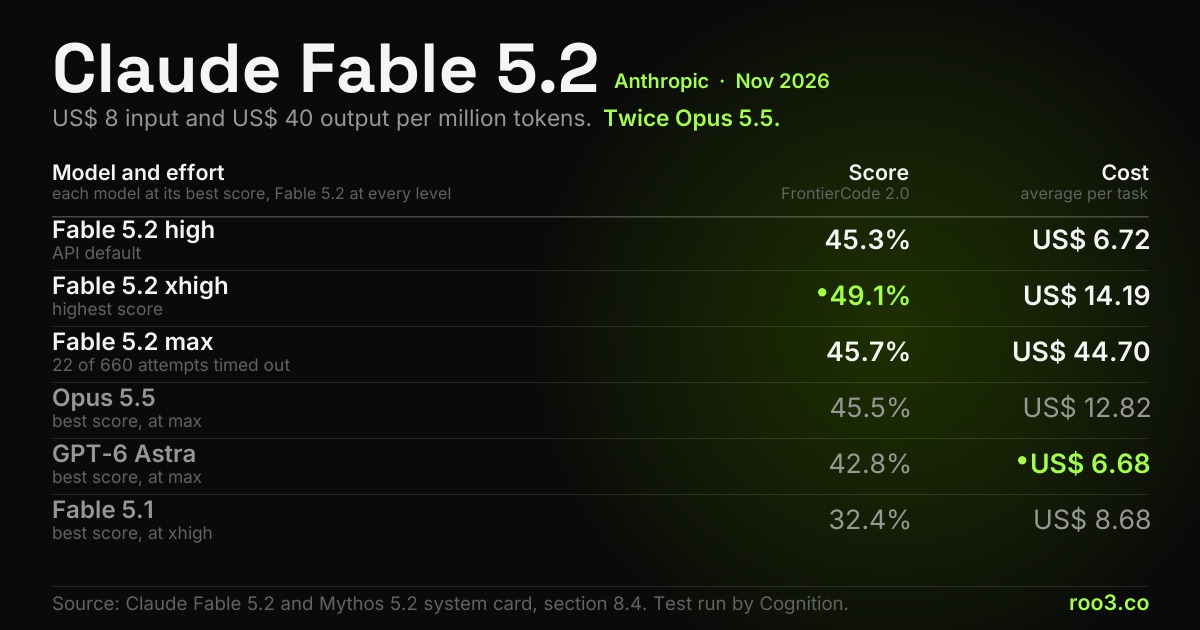
Claude Fable 5.2: what it is, pricing, pros and cons
Claude Fable 5.2: what it is, API and plan pricing, how it differs from Mythos 5.2 and Opus 5.5, benchmarks, pros, cons...
15 min read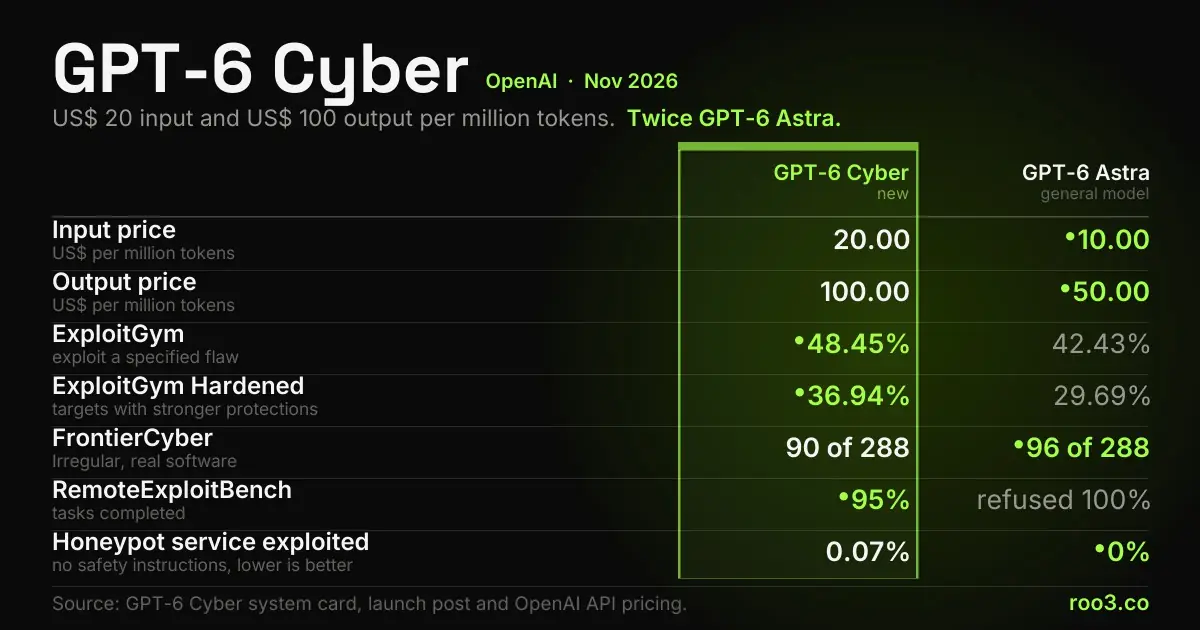
GPT-6 Cyber: what it is, pricing, pros and cons
GPT-6 Cyber: what it is, API pricing, who can use it, pros and cons, the 948 Linux exploits and what changes for anyone...
15 min read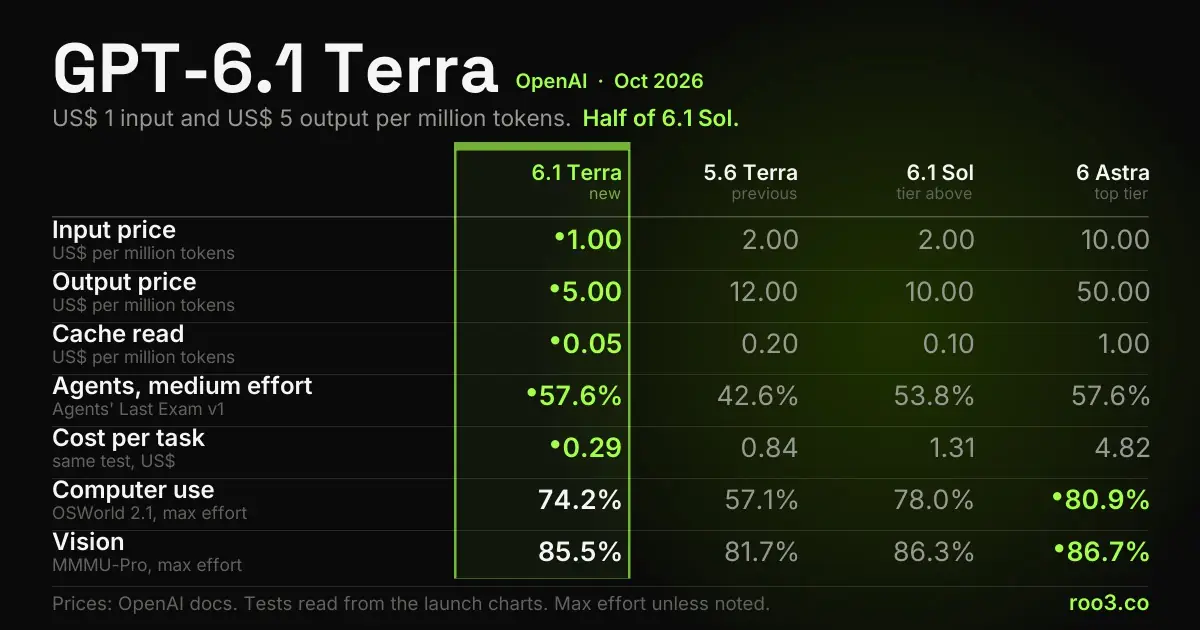
GPT-6.1 Terra: benchmarks, pricing and what changes on your bill
GPT-6.1 Terra: price per token and per task, benchmarks against GPT-5.6 Terra, GPT-6.1 Sol and GPT-6 Astra, independent...
10 min readWant to apply this in your company?
ROO3 diagnoses what can be automated first in your business. The first conversation is free.