GPT-6.1 Terra: OpenAI halved the price of its middle model, and it tied Astra on the agent test
Released on 26 October, GPT-6.1 Terra costs US$ 1 per million input tokens and US$ 5 output. On output, the drop from its predecessor is 58%, not 50%. It ties GPT-6 Astra on the agent test while spending sixteen times less per task, and it falls behind where the job is driving a screen.

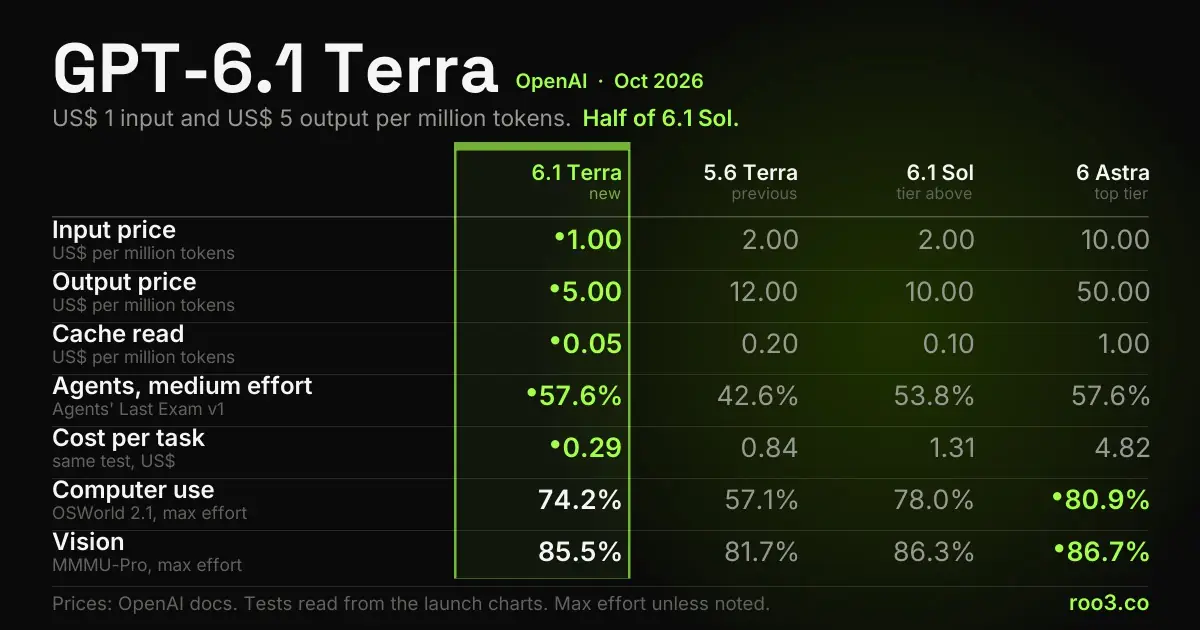
GPT-6.1 Terra is OpenAI's mid-tier model, released on 26 October 2026 under the identifier gpt-6.1-terra. It costs US$ 1 per million input tokens, US$ 5 output and US$ 0.05 for cache reads: half of GPT-6.1 Sol across the board and, against its predecessor GPT-5.6 Terra, 50% less on input, 58% less on output and 75% less on cache. In OpenAI's charts it scores 57.6% on Agents' Last Exam at medium effort, the same as GPT-6 Astra, spending US$ 0.29 per task against US$ 4.82. It loses to Sol and Astra on computer use and terminal work. Artificial Analysis measured a 38% hallucination rate, down from 88% for the predecessor. It shipped the same day on the API, ChatGPT Work, Codex and Amazon Bedrock, which does not offer it in the São Paulo region.
What you get from this article
- The API identifier is gpt-6.1-terra, with a 1.05 million token window, up to 128 thousand output tokens and a 1 June 2026 knowledge cutoff.
- Price: US$ 1 input, US$ 5 output and US$ 0.05 cache per million tokens. Above 272 thousand input tokens, the whole request moves to US$ 2 and US$ 7.50.
- Against GPT-5.6 Terra, input drops 50%, output 58% and cache 75%. Against GPT-6.1 Sol, everything drops by exactly half.
- On Agents' Last Exam at medium effort, it ties GPT-6 Astra (57.6%) spending US$ 0.29 per task, against US$ 4.82.
- It loses on computer use: 74.2% on OSWorld 2.1, against 78.0% for Sol and 80.9% for Astra.
- In Artificial Analysis's independent measurement, the hallucination rate fell from 88% to 38%.
- It has been on Amazon Bedrock since launch, but not in the São Paulo region.
What shipped, and how to confirm it
OpenAI released GPT-6.1 Terra on 26 October 2026. The way to confirm it without relying on screenshots is the developer documentation changelog, which describes the model as fast and efficient, aimed at visual reasoning, precise computer use and clear writing. The identifier is gpt-6.1-terra, and it already has its own page with published pricing.
In the current family, OpenAI works with four tiers: Luna, the cheapest, Terra, Sol and Astra at the top. The new Terra sits on the second step. There never was a GPT-6 Terra, so the direct predecessor is GPT-5.6 Terra, from July. For long research and complex code, OpenAI itself still points people to Sol or Astra.
The spec sheet is generous for a middle model: a 1.05 million token window, up to 128 thousand output tokens, text and image in, text only out, and knowledge up to 1 June 2026. It accepts six reasoning effort levels, from none to max, and uses the Responses API tools, including the one that drives a computer.
The table, with pricing and the tests you can check
OpenAI published the announcement results as charts, in image form. The numbers below were read from those charts by the trade press, and only the ones that appear identically in at least two independent transcriptions made it here. Pricing comes from the official documentation table.
The comparison is with the three in-house neighbours that matter for anyone deciding whether to switch: the predecessor, Sol, which is the tier above, and Astra, the top of the line.
| GPT-6.1 Terra new | GPT-5.6 Terra predecessor | GPT-6.1 Sol | GPT-6 Astra | |
|---|---|---|---|---|
| Input price US$ per million tokens | US$ 1 | US$ 2 | US$ 2 | US$ 10 |
| Output price US$ per million tokens | US$ 5 | US$ 12 | US$ 10 | US$ 50 |
| Cache read US$ per million tokens | US$ 0.05 | US$ 0.20 | US$ 0.10 | US$ 1 |
| Agents, medium effort Agents' Last Exam v1 | 57.6% | 42.6% | 53.8% | 57.6% |
| Cost per task on that test OpenAI estimate, US$ | 0.29 | 0.84 | 1.31 | 4.82 |
| Agents, max effort Agents' Last Exam v1 | 60.0% | 50.7% | 58.6% | 59.3% |
| Computer use OSWorld 2.1, max effort | 74.2% | 57.1% | 78.0% | 80.9% |
| Vision MMMU-Pro, max effort | 85.5% | 81.7% | 86.3% | 86.7% |
The price fell further than the headline says
The line going around is "half the price". It is exact against GPT-6.1 Sol, which costs US$ 2 and US$ 10, and exact on input against the predecessor. On output, though, GPT-5.6 Terra charged US$ 12, and the drop to US$ 5 is 58%. On cache reads, from US$ 0.20 to US$ 0.05, the drop is 75%. For agents and chat, which spend more on output and cache than on input, the real bill falls by more than half.
Outside OpenAI, Terra sits right in the middle of Anthropic's price list. It costs half of Claude Sonnet 5.5, which charges US$ 2 and US$ 10, and ten times Claude Haiku 5.5, which costs US$ 0.10 and US$ 0.50 on requests up to 100 thousand tokens. The same holds inside OpenAI: GPT-6 Luna charges US$ 0.10 and US$ 0.50.
There is a trap the short price table does not show. Above 272 thousand input tokens, the price moves to US$ 2 and US$ 7.50, and it applies to the whole request, not only to the part over the limit. Anyone sending a long contract or a whole document base in a single call pays double on input without noticing. In batch, through Batch or Flex, the price halves; in fast mode, it doubles.
Cost per task is the number that decides
Price per token only tells you what each word costs. What matters is what it costs to finish the job, and that is where Terra changes level. On Agents' Last Exam, a test of long agent tasks, it scores 57.6% at medium effort, the same as GPT-6 Astra, at an OpenAI-estimated US$ 0.29 per task. Astra spends US$ 4.82 to reach the same result, more than sixteen times the cost.
At max effort, Terra reaches 60.0%, ahead of Sol and Astra, spending US$ 1.01 per task. Claude Opus 5.5, which appears on the same chart, scores 63.2% at US$ 8.82. It is the classic choice between the best result and the best result per dollar: Opus solves a little more, and Terra solves almost as much for less than an eighth of the cost.
The outside measurement points the same way. Artificial Analysis ran Terra through its intelligence index on 26 October and arrived at US$ 0.40 per task, against US$ 1.40 for the predecessor, with 6 more index points at max effort. It placed 25th out of 221 models, 4 points below GPT-6.1 Sol.
Where it loses, and it should be said plainly
Terra was sold as a computer-use model, and that is exactly where it trails its bigger siblings. On OSWorld 2.1, which measures the ability to operate software through the screen, it scores 74.2% against 78.0% for Sol and 80.9% for Astra. Claude Sonnet 5.5 appears on the same chart at 83.9%. The jump over the predecessor, which scored 57.1%, is large, and it is still not the best in the category it puts on the box.
On long terminal work, the new Terra went from 21.5% to 50.3% on Terminal-Bench 4.0 at max effort, according to the chart transcriptions. That is more than double the predecessor and still below the models above it. OpenAI acknowledges this by recommending Sol or Astra for complex code.
Then there is waiting time. Artificial Analysis measured 90.9 tokens per second of generation, slightly above the market median, but 133 seconds to first token at max effort, because the model thinks before answering. OpenAI's claim that it finishes tasks over three times faster than Sol and Astra is about total agent task time, not the first word. For live customer service, effort has to stay low.
Fewer made-up facts, in the outside measurement too
OpenAI says Terra gets far fewer facts wrong. On the company's internal test, built with questions designed to induce mistakes, the error rate at low effort fell from 53.6% in the predecessor to 16.7%. At max effort it landed at 4.3%, 18 points below GPT-5.6 Terra. It is the company's own test, without open data, so it weighs less than an independent measurement.
The independent measurement exists and confirms the direction. On Artificial Analysis's AA-Omniscience, which penalizes a made-up answer when the model does not know, the hallucination rate went from 88% in the predecessor to 38% in the new Terra, with accuracy 2 points higher. It now says "I don't know" more often instead of inventing.
That 38% still means that when Terra does not know, it makes something up more than a third of the time. For text that goes to a customer, contract numbers, prices and deadlines, the checking rule does not change. We wrote about how to control this in AI hallucination.
What changes for a business in Brazil
In ChatGPT, Terra arrived in Work mode and in Codex for the Plus, Pro, Enterprise and Edu plans, with a higher usage limit than the predecessor. We found no indication that it is on the free plan. On the API, it shipped to everyone on the same day.
Amazon Bedrock also got the model on launch day, under the identifier openai.gpt-6.1-terra and at the same price as OpenAI on the global profile. The detail that matters to a Brazilian reader: the São Paulo region is not on the list, in any form. Anyone who must keep processing in Brazil because of a contract or a data policy cannot use Terra through Bedrock yet. Regions outside the global profile cost 10% more.
The safety card OpenAI published rates Terra as critical risk in cybersecurity, the highest level on the company's scale, with the same safeguards as Sol and Astra. That says less about your use and more about the moment: cheap models can already find flaws in other people's code, as last week's PHP2Shell flaw showed.
- On GPT-5.6 Terra today: switch, because the new one costs less and solves more. Test prompts that depend on output format first.
- On Sol for long agent tasks: compare with Terra at medium effort, which ties Astra on that test.
- Automation that operates screens and software: Sol and Astra still win, and Sonnet 5.5 beats all three.
- Requests above 272 thousand tokens: split the document or accept paying double on input.
- Live customer service: low or no effort, because max can take over two minutes to the first word.
What we cannot say yet
The test numbers in the announcement came as charts, and OpenAI did not publish the values as text. The transcriptions agree with each other on the numbers used here, but an official text table is still missing. Epoch AI and LMArena did not have Terra listed as of 27 October.
We also could not confirm whether Terra has reached Azure, or the exact list of ChatGPT modes where it shows up beyond Work and Codex. These points change little for anyone using the API, and we will update this page when there is a source.
What we can say already: for most office and agent tasks a small or mid-sized business runs, OpenAI's middle model is now good enough and cheap enough to be the default. If you want to know whether it fits your case before switching, ROO3 tests it on your real tasks, measures cost per task and sets up the switch safely. Talk to us.
Frequently asked questions
How much does GPT-6.1 Terra cost?
US$ 1 per million input tokens, US$ 5 output and US$ 0.05 for cache reads, on the standard tier and for requests up to 272 thousand input tokens. Above that, the whole request moves to US$ 2 and US$ 7.50. In batch the price halves, and in fast mode it doubles.
Does GPT-6.1 Terra really cost half of the previous one?
On input, yes: US$ 1 against US$ 2 for GPT-5.6 Terra. On output the drop is bigger, from US$ 12 to US$ 5, or 58%, and on cache reads it is 75%. Against GPT-6.1 Sol, every price drops by exactly half.
Is GPT-6.1 Terra better than GPT-6.1 Sol?
On agent tasks it gets close or passes it: on Agents' Last Exam it scores 57.6% at medium effort, against 53.8% for Sol, at less than a quarter of the cost per task. On computer use and terminal work, Sol stays ahead, and OpenAI recommends Sol or Astra for complex code and long research.
Where can I use GPT-6.1 Terra?
On the OpenAI API, in ChatGPT Work mode and Codex for the Plus, Pro, Enterprise and Edu plans, and on Amazon Bedrock since launch on 26 October 2026. On Bedrock, the São Paulo region does not offer the model.
Does GPT-6.1 Terra hallucinate less?
Yes, according to OpenAI and to independent measurement. Artificial Analysis measured a 38% hallucination rate on AA-Omniscience, against 88% for GPT-5.6 Terra. That is still high enough to require human checking on text that goes to customers.
Should I switch my current model to Terra?
If you use GPT-5.6 Terra, almost certainly, because the new one costs less and solves more. If you use Sol or Astra for agents, test Terra on your own tasks and measure cost per completed task. For screen automation, the larger models still win.
- OpenAI, API changelog (26 Oct 2026)
- OpenAI, gpt-6.1-terra model page
- OpenAI, API pricing
- OpenAI, GPT-6.1 Terra system card
- AWS, GPT-6.1 Terra on Amazon Bedrock (26 Oct 2026)
- Artificial Analysis, GPT-6.1 Terra pushes the cost efficiency frontier
- InfoWorld, OpenAI bets on AI economics with lower-cost GPT-6.1 Terra
- BleepingComputer, OpenAI launches GPT-6.1 Terra
Rodrigo Fávaro
Founder of ROO3, a marketing and technology agency in São José do Rio Preto, Brazil. Builds AI products running in production (Tobia, gerar.app, Pense Mercado) and maintains the AI Benchmark, a public ranking of AI models. See ROO3 AI consulting.
X @rodmf LinkedIn rodrigofavaroKeep reading
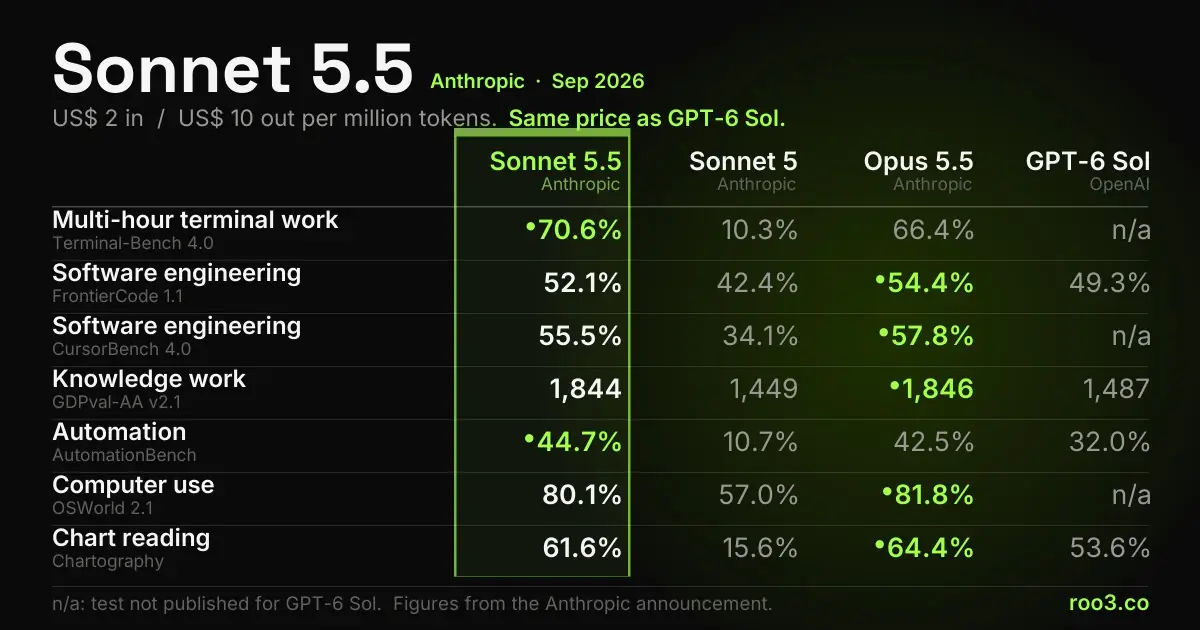
Sonnet 5.5: benchmarks, pricing and the real cost per task
Claude Sonnet 5.5 benchmarks against Opus 5.5, Sonnet 5 and GPT-6 Sol, a price identical to OpenAI's, and the effort...
16 min read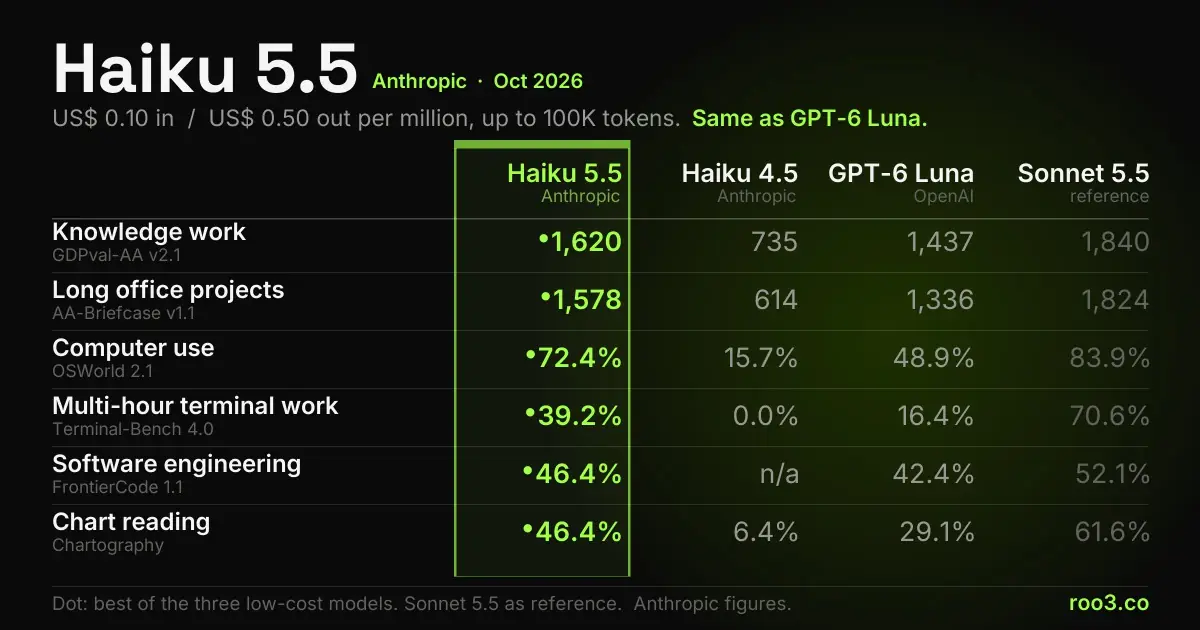
Haiku 5.5: benchmarks, pricing and the bill above 100K tokens
Claude Haiku 5.5 benchmarks and pricing against Haiku 4.5, GPT-6 Luna and Sonnet 5.5, the price tier above 100K tokens...
17 min read
Which AI is best today: how to compare without following opinion
How to compare AI models using public measurement instead of opinion: what the Epoch AI ECI is, what the Arena ELO is...
9 min readWant to apply this in your company?
ROO3 diagnoses what can be automated first in your business. The first conversation is free.