Claude Fable 5.2 and Mythos 5.2: what they are, what they cost, who can use them and when to move up from Opus 5.5
On 9 November 2026 Anthropic released a new version of its most capable models, 20% cheaper than the previous one and still twice the price of Opus 5.5 per token. The system card shows that, measured per task, the math can flip. Here is the pricing, the benchmarks, what breaks in your code and when the switch pays off.

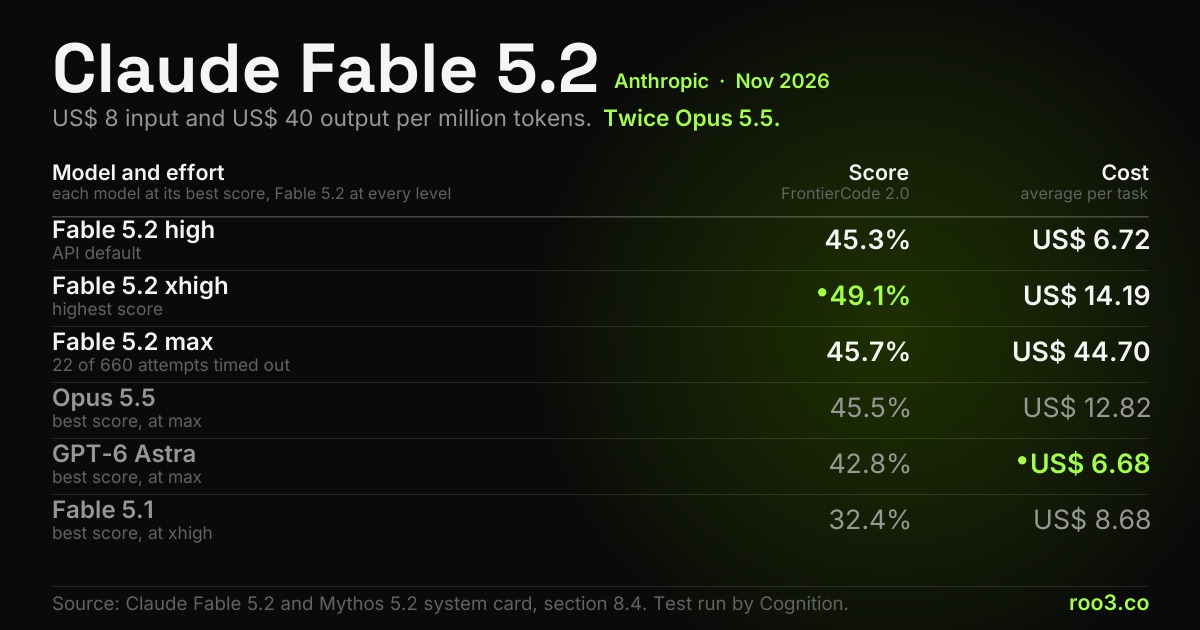
Claude Fable 5.2 is the most capable Anthropic model open to every customer, released on 9 November 2026 alongside Mythos 5.2. Both are the same model: Fable ships with safeguards that block cybersecurity tasks and biology research, and Mythos is limited to verified organizations. On the API it costs US$ 8 per million input tokens and US$ 40 per million output tokens, 20% less than Fable 5.1 and twice the price of Opus 5.5. The system card shows that at high effort it matches the best Opus 5.5 score on a coding test while spending about half as much per task. Anthropic itself recommends starting with Opus 5.5 and moving up to Fable when the results fall short.
What you get from this article
- Fable 5.2 and Mythos 5.2 are the same model. Fable blocks penetration testing, exploit writing and most biology research; Mythos is released only to verified organizations.
- On the API it costs US$ 8 input and US$ 40 output per million tokens: 20% less than Fable 5.1 and twice Opus 5.5. Cache reads cost the same US$ 0.20 as on Opus 5.5.
- On FrontierCode 2.0, high effort scored 45.3% at US$ 6.72 per task; the best Opus 5.5 score was 45.5% at US$ 12.82.
- Max effort did worse than xhigh on the same test (45.7% against 49.1%) and cost three times as much.
- In Anthropic's own table it loses on two rows: AutomationBench, to Gemini 4 Carbon, and the AA-Briefcase Elo, to Opus 5.5.
- Thinking is always on, forced tool use returns a 400 error and 30-day data retention is mandatory: code and contracts need a review before switching.
- On the Pro plan, Fable runs on usage credits. Until 16 November, the launch promotion includes up to 50% of the weekly limit at no extra cost.
What Claude Fable 5.2 is
Claude Fable 5.2 is the most capable language model Anthropic offers to all customers, released on 9 November 2026. The documentation describes it as built for demanding reasoning and long-horizon agent work: sessions that run for hours, multistep research and analysis carried through to a finished document, spreadsheet or deck. It replaces Fable 5.1, which remains available as a legacy model.
Claude Mythos 5.2 came out the same day. According to the announcement, Fable and Mythos are the same underlying model. The difference lies in the safeguards, explained in the next section. The specs are identical: a 1 million token context window, up to 128 thousand output tokens per response, text and image input, text output and reliable knowledge through June 2026. The API identifier is claude-fable-5-2, and Anthropic commits to keeping the model available until at least 9 November 2027.
Positioning is what matters most for whoever pays the bill. Anthropic itself recommends starting with Claude Opus 5.5 for most coding and knowledge work, and moving up to Fable when evaluations on Opus at higher effort still fall short. Fable 5.2 can also act as an advisor to smaller models (Haiku, Sonnet or Opus consult Fable on the hardest problems) or as an orchestrator that delegates the simple parts.
Fable 5.2 and Mythos 5.2: the difference
Fable 5.2 ships with safety classifiers that block high-risk cybersecurity activity, such as penetration testing, exploit generation and binary vulnerability analysis, plus most research biology tasks. When a request is blocked, the answer comes from another model: Opus 4.8 for security topics and Opus 5 for biology. Anthropic says that in early testing across claude.ai, Claude Code and Cowork, Fable 5.2 blocked about 55% fewer requests than Fable 5.1 (60% fewer in security and 40% fewer in biology).
Mythos 5.2 is the same model without those safeguards, and it is only available to organizations approved by the company's verification programs: the Cyber Verification Program for security and the Life Sciences Verification Program for biomedical research. Claude Enterprise customers outside the security program can use Mythos 5.2 indirectly through Claude Security, which scans code for vulnerabilities. Pricing and specs match Fable 5.2.
There is a third, less visible limit. During training, Anthropic deliberately held back the model's progress in the capabilities that most directly speed up AI development itself, such as kernel optimization for accelerators and improving language model architectures. In those areas, Fable 5.2 and Mythos 5.2 perform at about the level of Opus 5.5, and a small set of topics in that domain is answered by Opus 5. The company says agentic coding, hardware development and traditional machine learning research were not affected.
How much Claude Fable 5.2 costs
On the API, Fable 5.2 costs US$ 8 per million input tokens and US$ 40 per million output tokens, 20% less than Fable 5.1. Even after the cut, it is twice the price of Opus 5.5 in both directions. The exception is cache reads, billed at 2.5% of the input price: US$ 0.20 per million, the same as Opus 5.5. Workloads that reread a lot of cached context, such as a long contract or an agent's document base, pay less of a gap than the input and output table suggests.
Batch processing is half price (US$ 4 and US$ 20), and cache writes cost US$ 10 per million for 5 minutes and US$ 16 for 1 hour. Fast mode, which speeds up generation by up to 2.5 times according to the announcement, costs US$ 16 input and US$ 80 output and does not work with batch. It is available on the Anthropic API, in Claude Code, on both Google Cloud options and on Microsoft Foundry hosted by Anthropic. The model is also on Amazon Bedrock, Claude Platform on AWS and Microsoft Foundry.
In the apps, the rules depend on the subscription. Max, Ultra and premium Team seats include Fable models in their usage limits. On Pro and standard Team seats, Fable runs on usage credits, billed separately. For the launch, Pro and standard Team seats get a week with Fable included, up to 50% of the weekly limit, ending on 16 November at 11:59 pm Pacific time, plus one limit reset. Max, Ultra and premium seats get one to three resets, depending on how long they have subscribed, valid until 8 March 2027. The free plan is excluded, and the help center warns that Fable models use up limits faster than other models.
| Input | Output | Cache | |
|---|---|---|---|
| Fable 5.2 new | 8.00 | 40.00 | 0.20 |
| Mythos 5.2 verified only | 8.00 | 40.00 | 0.20 |
| Fable 5.1 previous | 10.00 | 50.00 | 0.25 |
| Opus 5.5 recommended start | 4.00 | 20.00 | 0.20 |
| Sonnet 5.5 speed and cost | 2.00 | 10.00 | 0.10 |
Cost per task and effort level
Price per token is only half the math. What drives the bill is how many tokens the model spends to finish the job, and that depends on effort, the parameter that controls how much it reasons before answering. Fable 5.2 has five levels: low, medium, high, xhigh and max. The API default is high; in the apps and in Claude Code, according to the announcement, the default is medium.
The system card reports the average cost per task on FrontierCode 2.0, a Cognition test that checks whether the model's code change would be accepted by open source maintainers. At high effort, Fable 5.2 scored 45.3% at US$ 6.72 per task. The best Opus 5.5 score was 45.5%, at US$ 12.82. At twice the per-token price, Fable reached the same result while spending about half.
The same table shows that the top level does not always pay off. Xhigh produced the highest score of any released model, 49.1%, at US$ 14.19. Max dropped to 45.7% and cost US$ 44.70 per task, and 22 of the 660 attempts timed out; counted as zero, the score would fall to 44.4%. Anthropic notes that each number is a single run with no error margin, so differences of a few tenths may mean nothing. The documentation advises starting at high, moving to xhigh only where a gain has been measured and keeping max for testing the model's ceiling.
| Score | Cost per task | |
|---|---|---|
| Fable 5.2 low lowest effort | 34.2% | US$ 2.10 |
| Fable 5.2 medium default in the apps | 37.6% | US$ 2.48 |
| Fable 5.2 high API default | 45.3% | US$ 6.72 |
| Fable 5.2 xhigh highest score | 49.1% | US$ 14.19 |
| Fable 5.2 max 22 of 660 timed out | 45.7% | US$ 44.70 |
| Opus 5.5 best score, at max | 45.5% | US$ 12.82 |
| GPT-6 Astra best score, at max | 42.8% | US$ 6.68 |
| Fable 5.1 best score, at xhigh | 32.4% | US$ 8.68 |
Benchmarks: where Fable 5.2 wins and where it loses
The announcement table compares Fable 5.2 with Fable 5.1, Opus 5.5, OpenAI's GPT-6 Astra and Google's Gemini 4 Carbon. On 10 of the 12 general capability rows, Fable 5.2 comes out ahead. The biggest jumps over its predecessor are in simulated robotics (from 27.6% to 64.9%), on the Remote Labor Index (from 17.9% to 41.3%) and in chart reading (from 44.8% to 73.4%).
It loses on two. On AutomationBench, a test of business workflows, Gemini 4 Carbon scored 53.9% against 51.4%. On AA-Briefcase, a knowledge work test, Fable wins on the rubric (66.1%) and trails Opus 5.5 on Elo, the head-to-head comparison (1,785 against 1,800). For anyone using AI on office work, such as reports and document analysis, the lead over Opus is small and depends on how it is measured.
The announcement's cybersecurity and protein rows are left out of the table below because they show Mythos 5.2, not Fable, which blocks most of those tasks. On CVE Rediscovery, an internal test that asks the model to find 1,829 already published flaws again, Mythos 5.2 found 10.2% more than Opus 5.5. A footnote in the same announcement adds a caveat: on the company's own evaluations, vulnerability identification is roughly on par with Opus 5.5. On languages, the system card reports a 96.0% average on Global MMLU across 42 languages, against 94.3% for Opus 5.5, with no per-language breakdown.
| Fable 5.2 Anthropic | Fable 5.1 Anthropic | Opus 5.5 Anthropic | GPT-6 Astra OpenAI | Gemini 4 Carbon Google | |
|---|---|---|---|---|---|
| FrontierCode 2.0 agentic coding | 49.1% | 32.4% | 45.5% | 42.8% | 41.1% |
| FrontierSWE v2 agentic coding | 69.9% | 56.3% | 62.3% | 65.5% | 61.2% |
| AutomationBench business workflows | 51.4% | 31.4% | 42.5% | 41.4% | 53.9% |
| Terminal-Bench-Science 0.1 agentic scientific research | 74.6% | 52.6% | 58.7% | 68.1% | 64.8% |
| WANDR agentic search, relaxed score | 82.1% | 68.7% | 72.3% | n/a | n/a |
| OSWorld 2.1 computer use | 89.3% | 83.5% | 87.2% | 79.5% | 81.5% |
| RoboDojo Sim robotics | 64.9% | 27.6% | 39.4% | 29.8% | n/a |
| AA-Briefcase v1.1 knowledge work, rubric | 66.1% | 61.5% | 61.2% | 52.0% | 61.8% |
| AA-Briefcase v1.1 knowledge work, Elo | 1,785 | 1,669 | 1,800 | 1,569 | 1,611 |
| Remote Labor Index knowledge work | 41.3% | 17.9% | 21.3% | 20.8% | n/a |
| Humanity's Last Exam reasoning, with tools | 74.2% | 65.6% | 67.7% | 57.2% | n/a |
| Chartography chart reading, no tools | 73.4% | 44.8% | 64.4% | 71.0% | 72.5% |
What it is for: what Anthropic and the testers did with it
The announcement's examples are long jobs with many agents running in parallel. An Anthropic engineer asked Fable 5.2 for a prototype operating system starting from an empty folder: the model coordinated more than 1,000 subagents over eight days and delivered a system that boots on a laptop, with disk, keyboard and network drivers, a login screen and an installer. A team of 1,000 agents formalized the proof of Fermat's Last Theorem in the Lean language in 30 hours; in the same setup, Opus 5.5 completed 26% in 18 hours.
There are engineering and science cases too. An Anthropic production service migrated from Python to Rust by agents now starts about 26 times faster. Three electronic devices designed by the model from a one-paragraph prompt, with circuit board, 3D-printed enclosure and software, worked without electrical modifications. In theoretical physics, the model solved two open problems about black holes, published as preprints. These results were released by Anthropic itself; the physics ones came out as preprints, not yet peer reviewed.
Among the statements from companies that tested it before launch, three help gauge business use:
- Oracle: on a query combining country debt, repayment history and regional benchmarks, Fable 5.2's SQL returned the expected value; two other models' SQL ran without errors and summed incorrectly, producing 5 to 8 times the correct amounts.
- Uber: a 10 to 12 hour security audit, with about 170 reviewer agents, ended with a write-up, fix pull requests and a policy proposal.
- Box: while reviewing the files of a loan application, the model flagged that the salary deposits did not match the bank statement balance.
What changes for developers on the API
Changing the model name is the easy part. The documentation lists four changes that can break code coming from Fable 5.1, plus rules that apply to every Fable 5.2 call. If Claude Code, claude.ai or the Agent SDK builds your requests, nothing changes; the care is for teams that build requests in their own code.
We counted in our own code: 7 AI calls, in two products we maintain, force a tool to get a structured answer, and were written for models that accept that, such as Haiku 4.5 and Sonnet 4.6. Pointed at Fable 5.2 without changes, every one of them would return a 400 error. The CRM on our site already had a fallback for models that refuse forced tool use: if the API returns the error, the call is retried in automatic mode.
- History must stay untouched: if your code edits, reorders or removes an earlier message, or changes the
systemprompt or the tools mid-conversation, the API rejects the thinking blocks with a 400 error. On Fable 5.1 the rule depended on account age; on 5.2 it applies to every account. - Thinking is tied to the model: only Fable 5.2 and Mythos 5.2 read Fable 5.2's thinking. A router that hands the conversation to Opus 5.5 or Fable 5.1 loses that reasoning in the following turns.
- Forced tool use:
tool_choiceset toanyortoolreturns a 400 error. Useautowithstrict: trueor JSON outputs. - Thinking is always on: you cannot turn it off or set a token budget; effort is the control. Omit
temperature,top_pandtop_k. - Asking it not to think does not work: in Anthropic's testing, lines such as "answer directly without deliberating" did not stop the model from thinking at medium and above. For simple questions, lower the effort.
- Turns that stop early: on long tasks, the model sometimes ends a turn with a list of what remains, more often at low and medium.
- Computer use: the older
computer_20251124tool errors outside Amazon Bedrock; use thecomputer_toolset_20260801toolset. - Data retention: the model requires 30-day retention for safety monitoring and does not run under zero data retention without express authorization from Anthropic.
Pros of Claude Fable 5.2
For long, hard tasks, the gains are measurable. The figures below come from the announcement and the system card, measured by Anthropic or its partners.
The most valuable gain in practice is the cost per completed task, because that is what decides whether an agent pays for itself.
- Cheaper than its predecessor: 20% less per token than Fable 5.1, with a higher score on all 12 rows of the table above.
- Lower cost per task than Opus 5.5: on FrontierCode 2.0, the same score for about half; on WANDR, the best Opus score for about 40% of the cost; on Humanity's Last Exam, for less than a tenth.
- Faster: output up to 30% faster than Fable 5.1, and up to 2.5 times faster in fast mode.
- Fewer unnecessary blocks: about 55% fewer refusals than Fable 5.1 in early testing.
- Stays in the sandbox: in a test of more than 1,800 scenarios designed to tempt the model to escape its sandbox, Mythos 5.2 used credentials or files left outside it in 3.1% of them, against 3.3% for Opus 5.5 and 21% for Mythos 5.1.
- Large context with no surcharge: 1 million tokens at the same per-token price, from the first token to the last.
Cons and limits of Claude Fable 5.2
The limits are in Anthropic's own documents and weigh more on high-volume use and short questions.
There is also a measurement limit. The system card says Fable 5.2 and Mythos 5.2 voice suspicion that they are being evaluated more often than any recent model from the company, which makes it harder to predict behavior outside the test.
- Price per token: twice Opus 5.5, and the model thinks before almost every reply from high upward. On a simple question, the bill goes up with no gain.
- Small lead on office work: it loses to Opus 5.5 on the AA-Briefcase Elo and to Gemini 4 Carbon on AutomationBench.
- Security and biology blocked: Fable refuses most of those tasks and answers with an older model. Mythos requires approval.
- Mandatory retention: 30 days of data storage at Anthropic, unless authorized or enrolled in Enterprise Frontier Safeguards, still in private beta.
- Migration takes work: forced tool use, editable history and routing between models need review before switching.
- Off the Pro plan, in effect: after launch week, Pro subscribers pay for Fable with usage credits.
Fable 5.2 or Opus 5.5: when to switch
Anthropic's own recommendation is a good starting point: Opus 5.5 as the everyday model, Fable 5.2 when Opus at high effort does not get there. What the system card adds is that this decision is measured per completed task, not by the price table. An agent that takes three attempts on Opus can come out cheaper on Fable if it gets it right the first time.
Fable 5.2 makes sense for agents that work alone for hours, such as system migrations, code audits and research across many sources; for analysis that has to get the math right and cross-check documents, as in the Oracle and Box cases; and as an advisor to a cheaper model, consulted only on the hard step. Customer service, message classification, summaries and short text belong on Sonnet 5.5 or Haiku 5.5, which the documentation itself points to for high volume and fast responses.
The test we recommend is simple: pick 20 real tasks from your business, run them on Opus 5.5 and Fable 5.2 at the default effort, and compare total cost and accuracy. The API console shows the tokens for each call. Without that test, switching is a guess.
Where ROO3 comes in
Fable 5.2 makes the usual question more expensive to get wrong: which model handles each of your company's tasks at the lowest cost that still delivers the result? In the system card, the same test cost from US$ 2.10 to US$ 44.70 per task on the same model, just from the choice of effort.
At ROO3, we build AI agents and automations for companies and choose the model task by task, measuring cost and accuracy before anything goes to production. When customer data is involved, the 30-day retention goes into the analysis together with Brazil's data protection law, the LGPD. Our AI consulting runs that test on your real tasks.
If you want to know whether paying twice per token is worth it, or whether your case fits a cheaper model, talk to us.
Frequently asked questions
What is Claude Fable 5.2?
It is the most capable Anthropic model available to every customer, released on 9 November 2026. It is built for hard reasoning and agents that work for hours, with a 1 million token context window and up to 128 thousand output tokens.
How much does Claude Fable 5.2 cost?
On the API, US$ 8 per million input tokens, US$ 40 per million output tokens and US$ 0.20 for cache reads. That is 20% less than Fable 5.1 and twice Opus 5.5. Batch is half price, and fast mode costs US$ 16 and US$ 80.
What is the difference between Claude Fable 5.2 and Claude Mythos 5.2?
They are the same model at the same price. Fable blocks high-risk cybersecurity tasks and most biology research and is open to everyone. Mythos has no such safeguards and is only released to organizations approved by Anthropic's verification programs.
Should I use Fable 5.2 or Opus 5.5?
Anthropic recommends starting with Opus 5.5 and moving up to Fable 5.2 when the results fall short. Fable costs twice as much per token, but on some tests it finishes the task for less, as on FrontierCode 2.0, where it matched the best Opus score for about half the cost.
Is Claude Fable 5.2 included in the Pro plan?
On Pro, Fable models run on usage credits, billed separately. During launch week, until 16 November 2026 at 11:59 pm Pacific time, Pro includes Fable for up to 50% of the weekly limit, plus one limit reset. Max, Ultra and premium Team seats already include Fable.
Does Fable 5.2 work in languages other than English?
Yes. The system card reports a 96.0% average on Global MMLU, a test run in 42 languages, above 94.3% for Opus 5.5. Per-language scores are not published, and the system card notes that output quality varies by language.
What breaks when switching to Fable 5.2 on the API?
Forcing a tool with tool_choice, turning thinking off and sending temperature or top_p return a 400 error. Editing earlier messages invalidates the thinking blocks, Fable 5.2 thinking is only read by itself and Mythos 5.2, and the older computer use tool is gone. The model also requires 30-day data retention.
- Anthropic, Introducing Claude Fable 5.2 and Claude Mythos 5.2 (9 Nov 2026)
- Anthropic, Claude Fable 5.2 and Claude Mythos 5.2 System Card (9 Nov 2026)
- Claude documentation: Claude Fable 5.2
- Claude documentation: What's new in Claude Fable 5.2
- Claude documentation: pricing
- Claude documentation: models overview
- Claude Help Center: Claude Fable 5.2 launch offers
- Claude Help Center: Cyber Verification Program
- @claudeai on X, Fable 5.2 and Mythos 5.2 announcement (9 Nov 2026)
Rodrigo Fávaro
Founder of ROO3, a marketing and technology agency in São José do Rio Preto, Brazil. Builds AI products running in production (Tobia, gerar.app, Pense Mercado) and maintains the AI Benchmark, a public ranking of AI models. See ROO3 AI consulting.
X @rodmf LinkedIn rodrigofavaroKeep reading
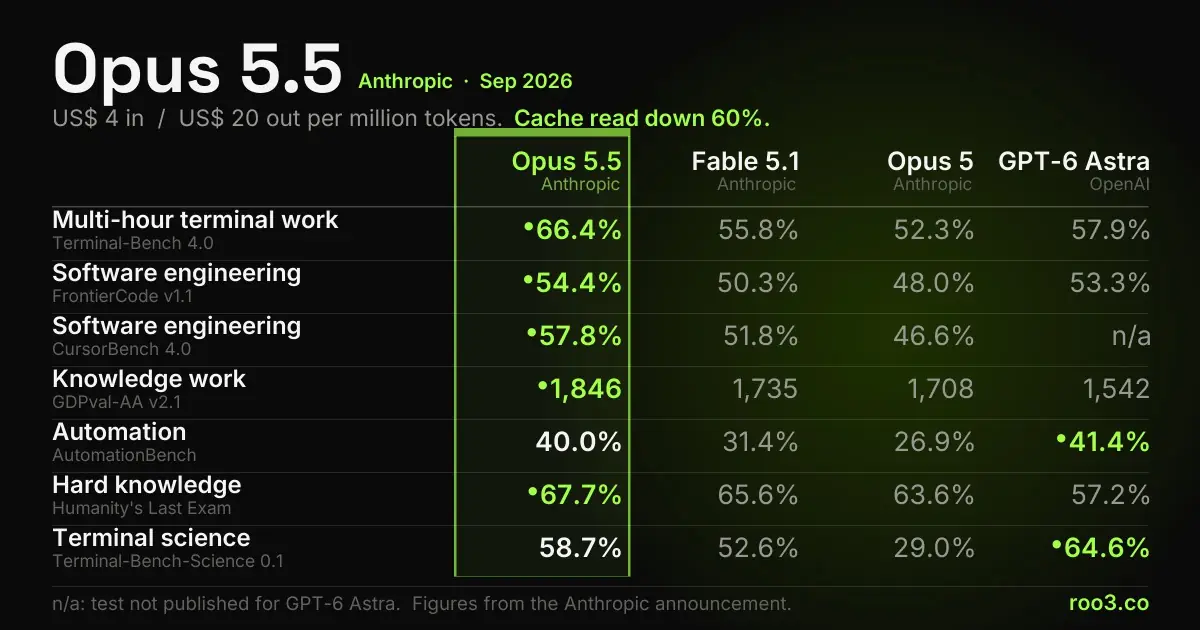
Opus 5.5: the expensive one got better and cheaper at once
Official Claude Opus 5.5 benchmarks against Fable 5.1, Opus 5 and GPT-6 Astra, the price per token, the 60% drop in...
11 min read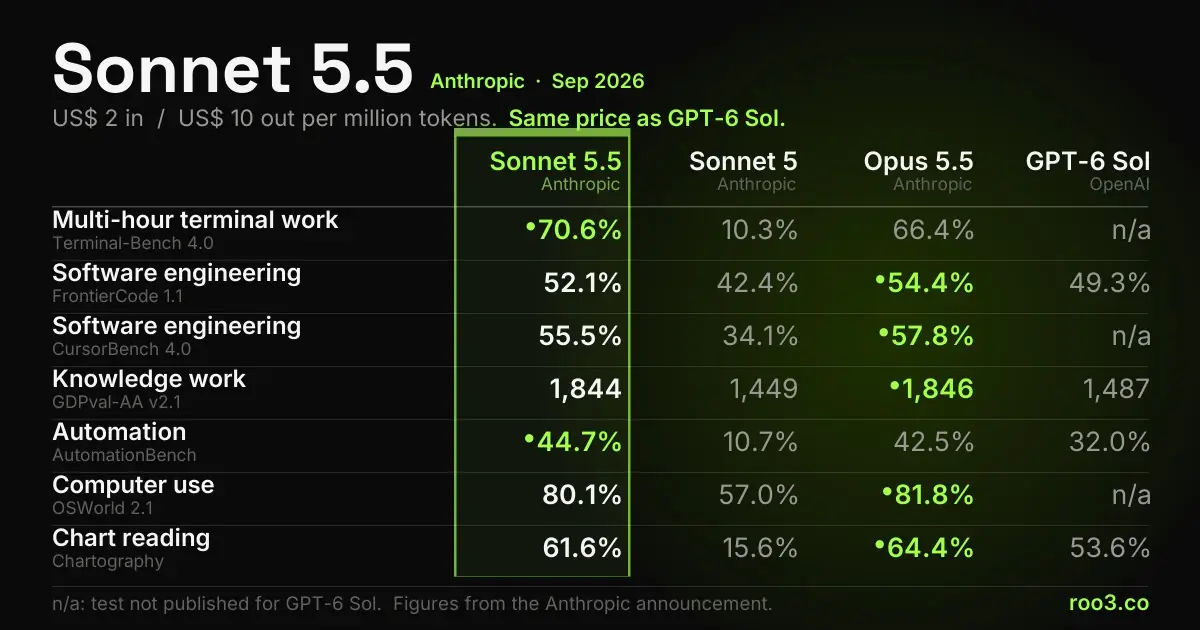
Sonnet 5.5: benchmarks, pricing and the real cost per task
Claude Sonnet 5.5 benchmarks against Opus 5.5, Sonnet 5 and GPT-6 Sol, a price identical to OpenAI's, and the effort...
16 min read
What agentic AI is: the difference between answering and doing
What agentic AI is, what separates an agent from a chatbot, where it genuinely works today, and the mandatory...
10 min readWant to apply this in your company?
ROO3 diagnoses what can be automated first in your business. The first conversation is free.