Kimi K3.1 Pro: what it is, what it costs to use or run, the license and where it falls behind
On 4 November 2026 Moonshot AI released the weights of Kimi K3.1 Pro, a 2.8-trillion-parameter model. The download is free, but running it is not. Here is the API price, the real cost of your own server, what the license allows and how it does in the maker's tests and in third-party ones.


Kimi K3.1 Pro is Moonshot AI's open-weight model, with 2.8 trillion parameters, a 1-million-token window and text and image input. It reached the API on 23 October 2026, and the weights were released on Hugging Face on 4 November. On the API it costs US$ 2 per million input tokens and US$ 10 per million output. The weights are free to download, but they add up to 1.56 TB and call for a server with eight B300-class GPUs, with rental starting at about US$ 34,500 a month. The license is its own: it allows commercial use and places conditions only on very large companies. In Moonshot's tests it comes close to Claude Opus 5.5 on coding; Artificial Analysis gives it 46 on its index and calls it slow and expensive among open models of its size.
What you get from this article
- Kimi K3.1 Pro has 2.8 trillion parameters, 104 billion active per token and a 1-million-token window.
- The API costs US$ 2 for input, US$ 10 for output and US$ 0.20 for cache per million tokens, below Kimi K3.
- The weights add up to 1.56 TB, and the vLLM recipe calls for eight GPUs, such as one B300 node.
- Renting that server around the clock costs about US$ 34,500 to US$ 102,500 a month, by our math.
- The license allows commercial use; its conditions apply to anyone selling the model as a service above US$ 20 million a year and to giant products.
- On Artificial Analysis it scores 46 on the index and takes 35.9 minutes per task, against a median of 13.7.
- Moonshot removed cybersecurity data from training before opening the weights.
What Kimi K3.1 Pro is
Kimi K3.1 Pro is an AI model from Moonshot AI, a Chinese lab, aimed at agents: long tasks in which the model plans, uses tools and corrects its own work. It was trained from Kimi K3, with reinforcement across hundreds of domains, and the company highlights coding, 3D creation and financial research.
The architecture is a mixture of experts: there are 2.8 trillion parameters in total, but only 104 billion come into play for each token. The context window is 1,048,576 tokens, and input is text and image. There is also a Highspeed version, two to three times faster, according to Moonshot.
The model reached the apps and API on 23 October 2026. The weights were published on Hugging Face on 4 November, as the company had promised.
What open weights means, and what the license allows
Open weights means the trained model file can be downloaded and run by anyone. Downloading costs nothing; running does, as the next section shows. The license is also not one of the traditional free software ones: Hugging Face marks the repository as "other", with Moonshot's own license.
For most companies the text is permissive. The conditions only bite for the very large:
- Allowed: using, copying, changing, distributing, selling, fine-tuning and creating derivatives, keeping the copyright notice.
- Model as a service: anyone operating that kind of business, with a group earning more than US$ 20 million in 12 months, needs a separate agreement with Moonshot before commercial use. An end-user product with the model embedded in specific features is outside that definition.
- Giant products: above 100 million monthly active users or US$ 20 million in monthly revenue, the name "Kimi K3.1-Pro" must be displayed prominently in the interface.
- Exceptions: internal use and use through official products or certified inference partners fall outside those two rules.
- No warranty: the software comes as is, with no liability for Moonshot.
How much Kimi K3.1 Pro costs on the API
Moonshot's API charges by use, with no subscription, and the model only becomes available after a minimum top-up of US$ 1. K3.1 Pro costs less than Kimi K3, its predecessor, and the price does not rise with context size. Batch requests come at 60% of the standard price.
In a price-table comparison, the US$ 2 and US$ 10 match Claude Sonnet 5.5 and GPT-6.1 Sol, and are half of Claude Opus 5.5. Artificial Analysis points out, however, that the price is high among open models of the same size, with a median of US$ 0.47 for input and US$ 1.97 for output. In its measurement, each index task cost US$ 3.68.
The model always reasons, and the default level is the maximum. You can lower it to low or high, but not switch it off, and that weighs on the output bill. There is also a charge for cache writes, of US$ 2 per million tokens for 5 minutes or US$ 4 for 1 hour.
| Input | Output | Cache | |
|---|---|---|---|
| K3.1 Pro standard | 2.00 | 10.00 | 0.20 |
| K3.1 Pro Highspeed 2 to 3 times faster | 4.00 | 20.00 | 0.20 |
| Kimi K3 previous | 3.00 | 15.00 | 0.30 |
How much it costs to run the weights yourself
The repository files add up to 1.56 TB. That rules out an ordinary computer and a small GPU server. The official vLLM recipe, one of the inference engines Moonshot recommends, starts at eight GPUs: two GB300 trays, one B300 node or one AMD MI355X node. The same recipe warns that throughput was not tuned.
Renting a node with eight B300 GPUs runs from US$ 48 an hour on Akash to US$ 142.42 on AWS, at October 2026 prices. Running all month, that is US$ 34,500 to US$ 102,500. Buying a DGX B300 costs US$ 300,000 to US$ 350,000 in reseller quotes, according to Telnyx, before power and operations.
For comparison: the US$ 34,560 of the cheapest rental buys about 3.5 billion output tokens on the API. If you process less than that a month, and have no requirement to keep data in-house, paying per token tends to cost less. The exact math depends on the real throughput of the server, which none of the sources published.
| Per hour | Per month 720 hours | |
|---|---|---|
| Akash starting at | US$ 48.00 | US$ 34,560 |
| Modal 8 x US$ 7.10 | US$ 56.80 | US$ 40,896 |
| AWS p6-b300.48xlarge | US$ 142.42 | US$ 102,542 |
How it does in tests
The table below comes from the model card, written by Moonshot. It wins on SWE Marathon, DeepSWE, HLE with tools and BrowseComp, lands within a point of Opus 5.5 on Terminal-Bench 4.0 and falls well behind on Program Bench, terminal science and reasoning without tools. The numbers have no independent confirmation, and many of the Kimi tests ran with Claude Code as the harness.
The most complete outside measurement is from Artificial Analysis: a score of 46 on index v5.0.1, against a median of 23 among open models of similar size. The price of that result is time. Each task took 35.9 minutes, against a median of 13.7, at 33 tokens per second.
On our AI Benchmark, which uses Epoch AI data, the model has 4 published tests: 60.8% on SciCode, 8th of 75 in its generation, and 91.0% on ProofBench, 9th of 62. The composite ECI index is not out yet, so it appears with no rank.
| Kimi K3.1 Pro | Opus 5.5 | Astra GPT-6 | |
|---|---|---|---|
| Terminal-Bench 4.0 terminal agent | 65.7 | 66.4 | 58.2 |
| SWE Marathon v1.1 coding | 51.7 | 46.3 | 42.5 |
| DeepSWE v1.1 software engineering | 75.5 | 74.2 | 74.1 |
| Program Bench coding | 31.5 | 65.0 | 50.0 |
| Terminal-Bench-Science terminal science | 38.1 | 63.3 | 68.1 |
| HLE with tools hard exam | 70.0 | 67.7 | 57.2 |
| HLE without tools hard exam | 51.1 | 59.8 | 53.6 |
| BrowseComp web research | 92.1 | 90.8 | 91.5 |
| OSWorld V2.1 computer use | 79.6 | 81.8 | 75.8 |
What it is for and how to use it
The most natural use is in coding agents and long tasks with many documents, making use of the 1-million-token window. Moonshot also points to financial research, 3D modeling and building pages. In every case, time and tokens have to go into the project math, because the model thinks a lot before answering.
There are three routes, from simplest to most demanding:
- Apps: Kimi.ai, Kimi Work and Kimi Code, to try it without code.
- API: at platform.kimi.ai, with an interface compatible with OpenAI and Anthropic. In conversations with tools, the full assistant message has to go back in the next call, with the reasoning.
- Own server: download the weights and run them with vLLM, SGLang or TokenSpeed, the engines Moonshot recommends.
Advantages of Kimi K3.1 Pro
The advantages below come from the model card, the license, Moonshot's documentation and Artificial Analysis measurements.
The advantage no closed model offers is the choice of where to run: anyone with their own server does not send data to the maker.
- Control: the weights can run on your own infrastructure.
- Broad license: allows commercial use, fine-tuning and derivatives for almost every company.
- Long context with no surcharge: 1 million tokens at a single price, with no tier by size.
- Price below its predecessor: US$ 2 and US$ 10, against US$ 3 and US$ 15 for Kimi K3.
- Cache and batch: cache reads at US$ 0.20 and batch requests at 60% of the price.
- Easy swap: API compatible with the OpenAI and Anthropic formats.
- Coding and research agents: beats Opus 5.5 on SWE Marathon and HLE with tools in Moonshot's numbers.
- Fewer factual errors: on Moonshot's hardest internal test, the rate of false claims fell from 23.4% on K3 to 8.3%.
- High score among open models: 46 on the Artificial Analysis index, double the median for its size.
Disadvantages and limits of Kimi K3.1 Pro
Open weights do not make the model cheap or simple. The limits below appear in its own documents or in third-party measurements.
There is also a question of personal data. Moonshot says enterprise customer data does not train models by default, and zero retention exists only for enterprises, on request, without covering batch processing or images and video uploaded directly.
- Running it yourself is expensive: 1.56 TB of weights and eight top-end GPUs, from about US$ 34,500 a month in rental.
- Slow: 35.9 minutes per task on Artificial Analysis, among the slowest for its size.
- Expensive among open models: the same source rates input and output as expensive against the median.
- Always reasons: it cannot be switched off, and the default is the maximum level.
- Behind on several tests: Program Bench, terminal science and HLE without tools, in Moonshot's own table.
- Fussier integration: reasoning has to go back in tool calls, and image input does not accept public URLs.
- Internal tests: some tests are the company's own, such as Kimi Code Bench and Kimi Hallu Bench.
- Vendor risk: The Next Web reports that the White House accused Moonshot in July of using banned Nvidia chips and copying an Anthropic model, without publishing evidence.
What cannot be stated yet
The throughput of a self-hosted server has not been published, so there is no reliable cost per token for anyone hosting it. Epoch AI's ECI is not out yet either, which is why the model cannot be compared on our ranking by the same yardstick as its rivals.
On privacy, the policy we could read applies to users in mainland China and sends everyone else to the kimi.ai site, whose version we could not open. So this article does not say where data sent to the API is kept. There is also a discrepancy: the model card lists text and image as input, and the API documentation also mentions video.
On safety, Moonshot says it removed cybersecurity data from training. In its internal test, the version without that cut solved 90.5% of flaw exploitation tasks and the final one 81.0%, against 33.3% for K3. The company states that it remains behind the best closed models, and the card confirms this on ExploitGym, at 20.7 against 42.4 for GPT-6 Astra. Downloaded weights cannot be recalled, which is part of why the time to update servers got shorter, the subject of our article on GPT-6 Cyber.
Who it is worth it for
Through the API, it is worth it for teams running coding agents or long-document analysis who accept slow answers and want mid-tier pricing. The test is direct: swap the model on a real task and compare result, time and cost with what you already use.
Running the weights makes sense for anyone with high volume, an infrastructure team and an obligation to keep data in-house, such as banks, healthcare, government and software companies. For a small or mid-size business, buying or renting that server rarely adds up.
It is worth less for real-time customer service, because answers take a while, and for anyone handling sensitive data through the API without having read the terms that apply to them.
Where ROO3 comes in
A new model ships every week. The useful question is which one solves your task at the lowest cost, with the level of risk the company accepts.
At ROO3, we track this on the AI Benchmark and use the models in production in our own systems. Our AI consulting helps a company choose between API and its own infrastructure, work out the real cost per task and define what can and cannot leave the building.
If you are weighing a model switch or bringing AI into a process that is manual today, talk to us.
Frequently asked questions
What is Kimi K3.1 Pro?
It is Moonshot AI's open-weight model, with 2.8 trillion parameters, 104 billion active per token and a 1-million-token window. It reached the API on 23 October 2026 and had its weights released on 4 November.
How much does Kimi K3.1 Pro cost?
On the API, US$ 2 per million input tokens, US$ 10 for output and US$ 0.20 for cache. The Highspeed version costs US$ 4 and US$ 20. Downloading the weights is free, but the server to run them is not.
Is Kimi K3.1 Pro open source?
It has open weights under Moonshot's own license, not a traditional free software license. Commercial use is allowed, with conditions for anyone selling the model as a service above US$ 20 million in 12 months and for very large products.
Can I use Kimi K3.1 Pro commercially?
The license allows it, and the conditions only reach very large companies. For a contract or a higher-risk product, have a lawyer read the text.
What hardware does Kimi K3.1 Pro need?
The weights are 1.56 TB. The vLLM recipe starts at eight GPUs, in two GB300 trays, one B300 node or one AMD MI355X node. Renting a B300 node costs US$ 48 to US$ 142.42 an hour, depending on the provider.
Is it better to run it yourself or use the API?
For most, the API. The cheapest server rental, about US$ 34,500 a month, buys about 3.5 billion output tokens. Running it yourself is justified by very high volume or a requirement to keep data in-house.
Is Kimi K3.1 Pro better than Claude Opus 5.5?
It depends on the task. In Moonshot's table it wins on SWE Marathon and HLE with tools, nearly ties on Terminal-Bench 4.0 and loses on Program Bench and on reasoning without tools. The numbers are the maker's.
Is my data safe on the Kimi API?
Moonshot says enterprise customer data does not train models by default and offers zero retention to enterprises on request. We could not read the full international policy, so check the terms for your case before sending sensitive data.
- Moonshot AI, Kimi K3.1 Pro model card on Hugging Face
- Moonshot AI, Kimi K3.1 Pro License
- Moonshot AI, Kimi K3.1 Pro Tech Blog
- Kimi API Platform, pricing
- Kimi API Platform, Kimi K3.1 Pro guide
- Kimi API Platform, Zero Data Retention
- Kimi, privacy policy (mainland China)
- vLLM Recipes, Kimi-K3.1-Pro
- Artificial Analysis, Kimi K3.1 Pro
- The Next Web, Moonshot releases Kimi K3.1 Pro and says it cut its hacking skills (23 Oct 2026)
- Telnyx, NVIDIA B300 pricing
- Akash, B300 rental price
- Kimi Moonshot on X, weights release (4 Nov 2026)
Rodrigo Fávaro
Founder of ROO3, a marketing and technology agency in São José do Rio Preto, Brazil. Builds AI products running in production (Tobia, gerar.app, Pense Mercado) and maintains the AI Benchmark, a public ranking of AI models. See ROO3 AI consulting.
X @rodmf LinkedIn rodrigofavaroKeep reading
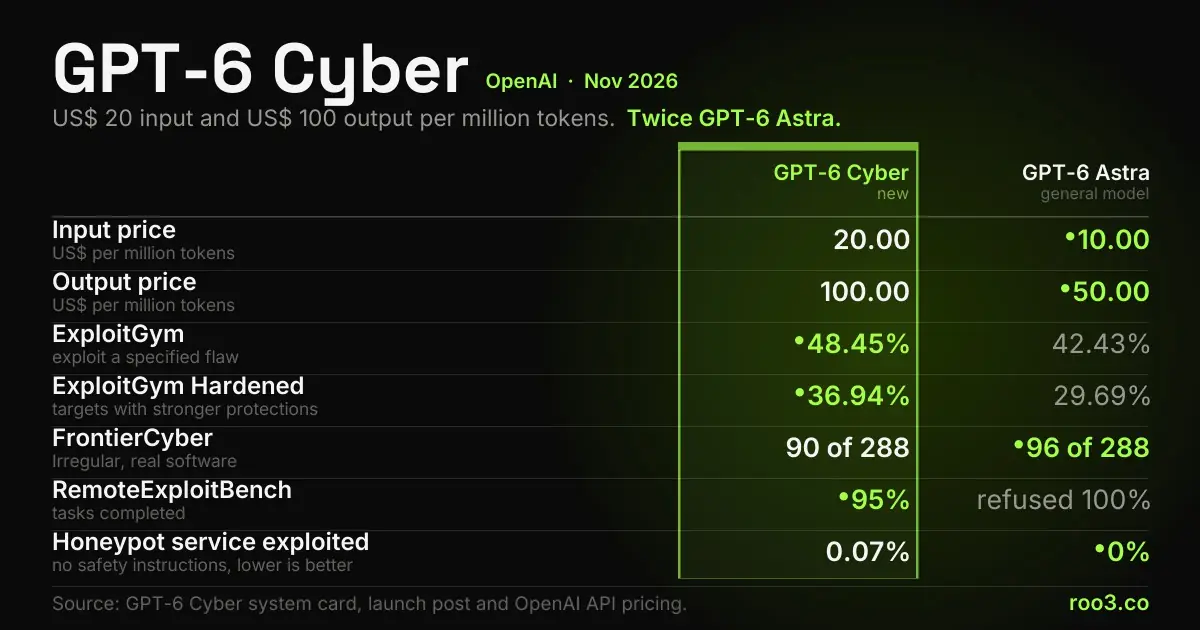
GPT-6 Cyber: what it is, pricing, pros and cons
GPT-6 Cyber: what it is, API pricing, who can use it, pros and cons, the 948 Linux exploits and what changes for anyone...
15 min read
LGPD and AI: using it without leaking customer data
What Brazilian data protection law requires of anyone using artificial intelligence: lawful basis, sensitive data...
11 min read
What an LLM is: how it works inside and what it does not do
What an LLM is, explained without maths: how the model predicts the next word, why that works so well, and which limits...
12 min readWant to apply this in your company?
ROO3 diagnoses what can be automated first in your business. The first conversation is free.