Muse Wonder is out: same price as Opus 5.5, and the version that tops the table has no API
Meta launched Muse Wonder on 12 October at the same price as Claude Opus 5.5. The model leading Meta's own table is Muse Wonder Full, which only exists inside a subscription. The version you can buy per token trails Opus in 9 of 14 rows.

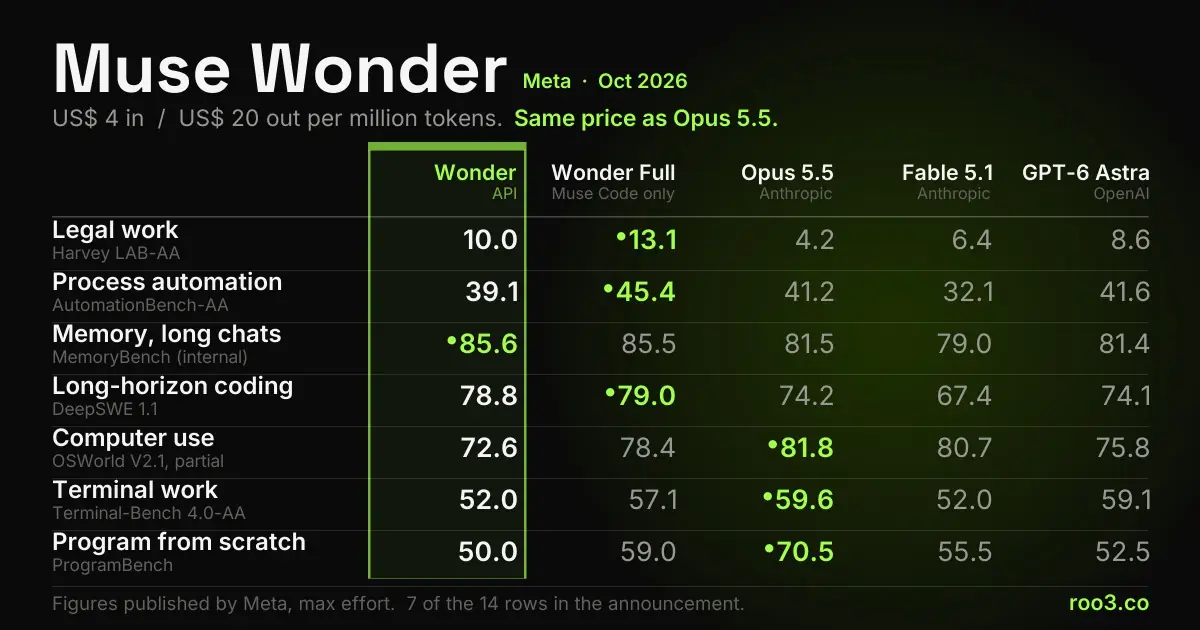
On 12 October 2026 Meta released Muse Wonder and Muse Wonder Full, the first frontier models from Meta Superintelligence Labs. Muse Wonder costs US$ 4 per million input tokens, US$ 0.20 for cached input and US$ 20 per million output tokens on the Meta Model API, exactly the price of Claude Opus 5.5. In Meta's own 14-row table, the Muse Wonder family posts the top score in 7 rows and Opus 5.5 in 6, but almost every win belongs to Wonder Full, which only exists inside a Muse Code subscription, with no API. The version sold per token trails Opus 5.5 in 9 of the 14. And in Muse Code, the mode that lets Meta train models on your code is switched on by default.
What you get from this article
- Two models: Muse Wonder (muse-wonder-1.0), on the Meta Model API and in Muse Code, and Muse Wonder Full, only in a Muse Code subscription, from US$ 50 a month.
- Muse Wonder costs US$ 4 input, US$ 0.20 cached input and US$ 20 output per million tokens: the price of Claude Opus 5.5, with no surcharge across the 1-million-token window.
- In Meta's table, Wonder Full posts the top score in 6 of 14 rows, almost all of them in office agents and long-horizon coding.
- Muse Wonder, the one you buy per token, trails Opus 5.5 in 9 of the 14 rows Meta itself published.
- Three results in the table are Meta's internal benchmarks, and competitors were run on a "best-effort" basis, in the words of the technical report.
- In Muse Code, Contributor mode, which uses prompts, code and files to train Meta models, is on by default. On the pay-as-you-go API it does not exist for Muse Wonder.
- As of 13 October, no independent measurement had been published: Epoch AI had only registered the model.
What Meta released, and where you can use it
Mark Zuckerberg announced Muse Wonder on X on 12 October 2026 as Meta's new family of frontier models. There are two models. Muse Wonder is the fast version, and Muse Wonder Full is the full model. Both come from Meta Superintelligence Labs, the division Meta set up a little over a year ago to rebuild its AI from scratch, and both succeed Muse Spark, released in April.
The confirmation does not rest on a screenshot. The identifier muse-wonder-1.0 is in the Meta Model API documentation with published pricing, and the technical report (model card) gives the release date, the method behind each benchmark and the safety evaluations. Every number in this piece comes from those pages, and the table in the announcement matches the one on the developer page cell for cell.
The published spec sheet for Muse Wonder: a 1,048,576-token context window, text, image, video, audio and PDF input, text output, and reasoning effort adjustable from "minimal" to "max". It was trained at Prometheus, Meta's gigawatt-scale data center. The documentation still labels the model a preview, and neither the knowledge cutoff nor the maximum output length has been published.
Where each version runs is the first difference that matters to whoever pays the bill:
- Muse Wonder (
muse-wonder-1.0): on the Meta Model API, billed per token, and in Muse Code, Meta's terminal coding tool, on every plan. The model page also points to OpenRouter. - Muse Wonder Full (
muse-wonder-full-1.0): only in Muse Code, on the Power Usage (US$ 50 a month) and Maximum Usage (US$ 200 a month) plans. No API and no per-token price. - The Muse app: Meta's personal agent will run on Muse Wonder "soon", subscribers first. The agent launched in September in the United States only.
Meta's table, row by row
Meta published 14 result rows, all at maximum effort, against three models: Claude Opus 5.5 and Claude Fable 5.1 from Anthropic, and GPT-6 Astra from OpenAI. Counting the top score in each row, the Muse Wonder family takes 7 (six for Full and one for Wonder), Opus 5.5 takes 6 and GPT-6 Astra takes 1. Fable 5.1 leads none.
Meta's wins cluster in two kinds of work. The first is office agents: Full leads legal work (Harvey LAB-AA, 13.1 against 8.6 for the best rival), financial analysis and process automation. The second is long-horizon coding: 79.0 on DeepSWE against 74.2 for Opus 5.5, and 57.5 on SWE-Marathon, a benchmark of very long engineering projects, against 46.3. The losses have a pattern too: writing a program from scratch (ProgramBench, 59.0 against 70.5 for Opus), terminal work, operating a computer through the screen, and health questions.
| Muse Wonder API, US$ 4 / US$ 20 | Wonder Full Muse Code only | Opus 5.5 US$ 4 / US$ 20 | Fable 5.1 US$ 10 / US$ 50 | GPT-6 Astra US$ 10 / US$ 50 | |
|---|---|---|---|---|---|
| Personal agent index Personal Superintelligence Index, internal | 54.3 | 59.1 | 55.2 | 49.9 | 54.5 |
| Legal work Harvey LAB-AA | 10.0 | 13.1 | 4.2 | 6.4 | 8.6 |
| Financial analysis Vals Finance Agent V2 | 56.6 | 59.1 | 58.6 | 58.9 | 53.5 |
| Health questions HealthBench Pro | 60.5 | 62.3 | 65.6 | 62.1 | 65.3 |
| Process automation AutomationBench-AA | 39.1 | 45.4 | 41.2 | 32.1 | 41.6 |
| Work from PDF sources GDP.pdf | 30.8 | 33.2 | 30.6 | 27.6 | 34.2 |
| Office tasks with tools JobBench | 70.5 | 75.3 | 75.4 | 73.1 | 66.1 |
| Computer use OSWorld V2.1, partial score | 72.6 | 78.4 | 81.8 | 80.7 | 75.8 |
| Memory across long chats MemoryBench, internal | 85.6 | 85.5 | 81.5 | 79.0 | 81.4 |
| Terminal work Terminal-Bench 4.0-AA | 52.0 | 57.1 | 59.6 | 52.0 | 59.1 |
| Long-horizon coding DeepSWE 1.1 | 78.8 | 79.0 | 74.2 | 67.4 | 74.1 |
| Very long projects SWE-Marathon | 53.1 | 57.5 (xhigh) | 46.3 | 45.6 | 42.5 |
| Program written from scratch ProgramBench | 50.0 | 59.0 | 70.5 | 55.5 | 52.5 |
| General index Artificial Analysis, as cited by Meta | 52 | 56 | 58 | 53 | 53 |
Read at a glance, the table misleads on one point. The column that wins most is Full, and Full is not a model you put inside a system: it runs in Muse Code, for people who code in a terminal. Anyone wiring AI into customer support, a CRM or a document workflow buys Muse Wonder, and its column tells a different story.
Same price as Opus 5.5: the comparison that matters
Muse Wonder costs US$ 4 per million input tokens, US$ 0.20 for cached input and US$ 20 per million output tokens. That is Claude Opus 5.5's price sheet to the cent, on all three lines. With price tied, the comparison comes down to scores, and across Meta's own 14 rows Opus 5.5 beats Muse Wonder in 9.
Muse Wonder wins five: legal work (10.0 against 4.2), memory across long chats (85.6 against 81.5), both long-horizon coding benchmarks (78.8 against 74.2 on DeepSWE and 53.1 against 46.3 on SWE-Marathon), and work from PDF sources, by 0.2 points. Opus takes the rest, by a wide margin in three: a program written from scratch (70.5 against 50.0), computer use (81.8 against 72.6) and terminal work (59.6 against 52.0). On FocusBench, the task-persistence test Meta published separately, Opus 5.5 also comes out ahead, 45.8% against 44.9%.
Against the pricier models in the table, the math changes. Claude Fable 5.1 and GPT-6 Astra charge US$ 10 input and US$ 50 output, and Muse Wonder costs 40% of that. Against Fable 5.1, Wonder wins 7 rows, loses 6 and ties one. Against Astra, it wins 6 and loses 8. Staying close to Fable 5.1 at two fifths of the price is Meta's strongest commercial argument, more than leading the table.
Two lines of the price sheet favor Muse Wonder. There is no long-context surcharge: a request that fills almost the whole window pays the same per-token rate as a short one, as with Anthropic, while OpenAI charges US$ 20 and US$ 75 for GPT-6 Astra above 272K tokens. Web search costs US$ 2.50 per 1,000 searches on top of tokens. Against its own smaller sibling, Muse Spark 1.3, Wonder costs 3.2 times more on input and about 4.7 times more on output. If Spark already handles your task, there is no reason to switch.
An identical price takes price out of the conversation. What is left is which model gets your kind of work wrong less often, and Meta's own table answers that better than the headline.
How Meta measured, and why it changes the reading
Every number so far was published by the seller. Meta's technical report describes the method benchmark by benchmark, and that description shows limits the table alone hides.
- Three results are in-house. MemoryBench and FocusBench are Meta's internal evaluations, and the personal agent index (PSI) blends seven benchmarks, including FocusBench and another internal browsing test. The Muse family leads all three.
- Competitors run on a "best-effort" basis. Where no third-party or provider-reported result existed, Meta ran rivals itself, and the report warns that prompts, tools and runtime may not be optimally tuned for other companies' models.
- SWE-Marathon is not a controlled comparison. The report says so plainly: GPT-6 Astra ran in Codex, Fable 5.1 in Claude Code, and Wonder Full was measured at xhigh, not max.
- Some benchmarks come from third parties. Artificial Analysis (legal work, automation and terminal), Vals AI (finance), Surge (PDF) and Datacurve (DeepSWE). Those results carry more weight than the internal ones.
- Refusals count as failures. A request the model refuses stays in the count with a score of zero instead of being dropped. It is the harsher choice for Meta's own model.
The Artificial Analysis general index, which Meta put in its own announcement, sums it up: Opus 5.5 at 58, Wonder Full at 56 and Muse Wonder at 52, level with GPT-6.1 Sol and one point behind Fable 5.1 and GPT-6 Astra. Meta has reached the frontier, as the announcement says. It has not yet passed Opus 5.5 on the broadest measure it chose to show.
The announcement also makes an argument without a table, about generalization. According to Meta, Wonder Full does better on tasks it was not trained for than Muse Spark 1.3 would at the same level of in-training performance, because it starts from a larger base model. It is a direct answer to the suspicion that models are tuned to ace benchmarks. The chart is Meta's own, with no per-task numbers published.
Wonder Full lives inside Muse Code
The model that leads the table has no API. Muse Wonder Full only runs in Muse Code, the multi-agent coding tool Meta offers in the terminal, and only on the two most expensive plans. The documentation makes a point of it: setting reasoning to max on the API version of Muse Wonder does not route the request to Full.
Muse Code plans, according to the product page:
- Everyday Usage, US$ 5 a month: 10 to 50 prompts every 5 hours, with access to the Muse family, Muse Wonder included.
- High Usage, US$ 15 a month: 5 times the usage of the Everyday plan.
- Power Usage, US$ 50 a month: 20 times the usage, and the first plan with Wonder Full.
- Maximum Usage, US$ 200 a month: 80 times the usage, also with Wonder Full.
For developers, US$ 50 a month for the model with the best long-horizon coding scores in the table is trial money, and the trial is worth running. For a company that wants AI inside a process, such as customer support, document triage or a CRM, Full is not an option today, because there is no way to call it from another system. The real choice is between Muse Wonder and the Anthropic, OpenAI and Google models that already have an API.
The mode that trains on your code is on
This is the point that weighs most for companies, and it is not in the announcement. Meta offers two modes. In Standard mode, what you send (prompts, code, files, context and the model's responses) is not used to train Meta models. In Contributor mode you get more usage, or a lower price, and in exchange you let Meta use that content to train future models.
On the Meta Model API, Muse Wonder only runs in Standard mode: paying per token does not train Meta. Muse Code is the opposite. The documentation says subscriptions start in Contributor mode, on by default, and that you can turn it off at any time in settings.
For a business, this is a data-protection and contract question. Anyone who opens a repository with customer data, a contract or an HR spreadsheet in Muse Code without touching the setting is handing that material over for training. Turning it off is easy. The risk is that nobody remembers to. If your team is going to try Muse Code, switch Contributor off before the first session and write the rule into your internal AI use policy.
Through the API, Muse Wonder does not learn from what you send. In Muse Code it does, until someone switches it off.
Safety: what the technical report admits
Meta assessed the most capable version, Full, under its own risk framework. Without safeguards, the company does not rule out the model reaching the high risk threshold in chemistry and biology, so it applied safety training and system-level classifiers. With safeguards in place, it rates the risk moderate or lower across all domains. For cybersecurity and loss of control, the model was already at that level without them.
One cybersecurity figure shows capability better than the rating does. On ExploitGym, Full captured 92 flags, but only 21 through the vulnerability the benchmark intended. The other 71 came through flaws the benchmark authors had not anticipated. For defenders, that is useful capability. For anyone giving an agent access to a server, it is proof that it finds paths nobody designed.
On behavior, Meta reports a 0% harmful action rate on the agentic misalignment test and 87.3% on MASK, which measures whether a model stays honest under pressure. The report also lists limitations: visual and spatial reasoning, especially 3D, and performance that may degrade in languages outside the strongly supported set. For agents, the recommendation is human confirmation before any irreversible action. The full safety report, Meta says, is coming soon.
What has been measured outside Meta
Nothing, as of this writing. Our AI Benchmark only gathers measurements that do not depend on the vendor, and Muse Wonder entered it on its own at 17:25 Brasília time on 12 October, in the first update after Epoch AI registered it, with seven reasoning levels from minimal to max. No benchmark has come out yet: no Epoch AI index, no Arena score and no LiveBench.
Wonder Full has not even been registered. With no API, independent evaluators cannot test it the way they test the others, and it may never show up in an outside measurement. That is why it sits in the AI Benchmark as an announced model, with its own page and an analysis of what Meta published, with no independent score.
When measurements of Muse Wonder come out, it moves into the ranking without anyone typing a number. The Muse Wonder page already shows the spec sheet, pricing and analysis, and will show the scores as soon as they exist.
What to do this week
If you use AI through an app, nothing changes for now: Muse Wonder reaches Muse "soon", subscribers first, and the Muse agent launched in the United States only.
If you run a system that calls a model API, the decisions fit in five lines:
- If you use Opus 5.5 for long-horizon coding or reading legal documents, test Muse Wonder on the same tasks. The price is the same, and those are exactly the rows where it wins in Meta's table.
- If the work is computer use, terminal work or writing programs from scratch, stay put. Those are the rows where Opus 5.5 pulls furthest ahead.
- If you pay for Fable 5.1 or GPT-6 Astra, Muse Wonder costs 40% of that and stays close across much of the table. That is the case with the best odds of saving money, and the first one to test.
- If your team is going to try Muse Code, switch Contributor mode off before opening any repository or customer document.
- If Muse Spark 1.3 already does the job, stay on it: Wonder costs 3.2 times more on input and about 4.7 times more on output.
The cheap way to decide is to measure: pick ten real tasks, run them on the candidate models and record accuracy and cost for each. It takes an afternoon and saves months of paying for the wrong model. That test is where ROO3's AI consulting for businesses starts, because a model that shines in a launch table is not always the best at the work of the people who will use it.
What we cannot say yet
First, where Muse Wonder ranks. Without independent measurement, all we have is Meta's table, with three in-house results and rivals run on a best-effort basis. It points to strength in long-horizon coding and office agents, but it does not prove it.
Second, availability by country. The Meta Model API works in most countries where Meta AI is available, and Brazil is not on the restricted list in Meta's geographic use policy. For Muse Wonder inside the Muse app, there is no date and no country list.
Third, what Meta will do with the rest of the lineup. The announcement says Muse Wonder will be used to develop specialized models for everyone using Muse. If those smaller models inherit part of the capability at Muse Spark prices, the math for high-volume users will shift more than it did with this launch. For the model Muse Wonder has to beat at the same price, see our Opus 5.5 analysis.
Frequently asked questions
What is Muse Wonder?
It is Meta's new family of AI models, released on 12 October 2026 by Meta Superintelligence Labs. It comes in two versions: Muse Wonder, sold per token on the Meta Model API and used in Muse Code, and Muse Wonder Full, the higher-capability version, only in a Muse Code subscription. Both are built for agents that do office work and long-horizon coding, with a 1,048,576-token context window.
How much does Muse Wonder cost?
On the Meta Model API, US$ 4 per million input tokens, US$ 0.20 for cached input and US$ 20 per million output tokens, with no long-context surcharge. Web search costs US$ 2.50 per 1,000 searches. Muse Wonder Full has no per-token price: it comes with the Muse Code Power Usage (US$ 50 a month) and Maximum Usage (US$ 200 a month) plans.
Is Muse Wonder better than Claude Opus 5.5?
It costs the same and, in the table Meta itself published, trails Opus 5.5 in 9 of 14 benchmarks. It wins on long-horizon coding (DeepSWE and SWE-Marathon), memory across long chats, legal work and work from PDF sources. Muse Wonder Full beats Opus 5.5 in 8 of 14, but it only exists inside Muse Code, with no API.
Can I use Muse Wonder Full through the API?
No. Meta's documentation says Full is only available in Muse Code, on the Power Usage and Maximum Usage plans, and that setting reasoning to max on the API version of Muse Wonder does not select Full.
Does Muse Code use my code to train Meta's AI?
By default, yes. In Muse Code subscriptions, Contributor mode is on: it gives you more usage in exchange for letting Meta use prompts, code, files and responses to train future models. You can turn it off in settings. On the Meta Model API, Muse Wonder only runs in Standard mode, where content is not used for training.
Is Muse Wonder in ROO3's AI Benchmark yet?
Yes, since 17:25 Brasília time on 12 October 2026, when Epoch AI registered it, still with no benchmark measured. Muse Wonder Full appears as an announced model, because no independent source has registered it. Both have a page with an analysis of what Meta published, and independent scores will appear on their own once they are out.
- Mark Zuckerberg on X, Muse Wonder announcement (12 October 2026)
- Meta, Muse Wonder: A Frontier Model For Personal & Professional AI Agents (announcement, table and charts)
- Meta, Muse Wonder Model Card (method for each benchmark and safety evaluations)
- Meta for Developers, Muse Wonder page (identifiers, pricing and plans)
- Meta Model API, Models (context window, availability and reasoning levels)
- Meta Model API, Pricing and rate limits (pricing, Standard and Contributor modes)
- Meta, Muse Code (subscription plans)
- Claude Platform Docs, Pricing (Opus 5.5 and Fable 5.1 pricing)
- OpenAI, API pricing (GPT-6 Astra pricing, including long context)
- Epoch AI, benchmark data (Muse Wonder registration, under CC BY 4.0)
Rodrigo Fávaro
Founder of ROO3, a marketing and technology agency in São José do Rio Preto, Brazil. Builds AI products running in production (Tobia, gerar.app, Pense Mercado) and maintains the AI Benchmark, a public ranking of AI models. See ROO3 AI consulting.
X @rodmf LinkedIn rodrigofavaroKeep reading
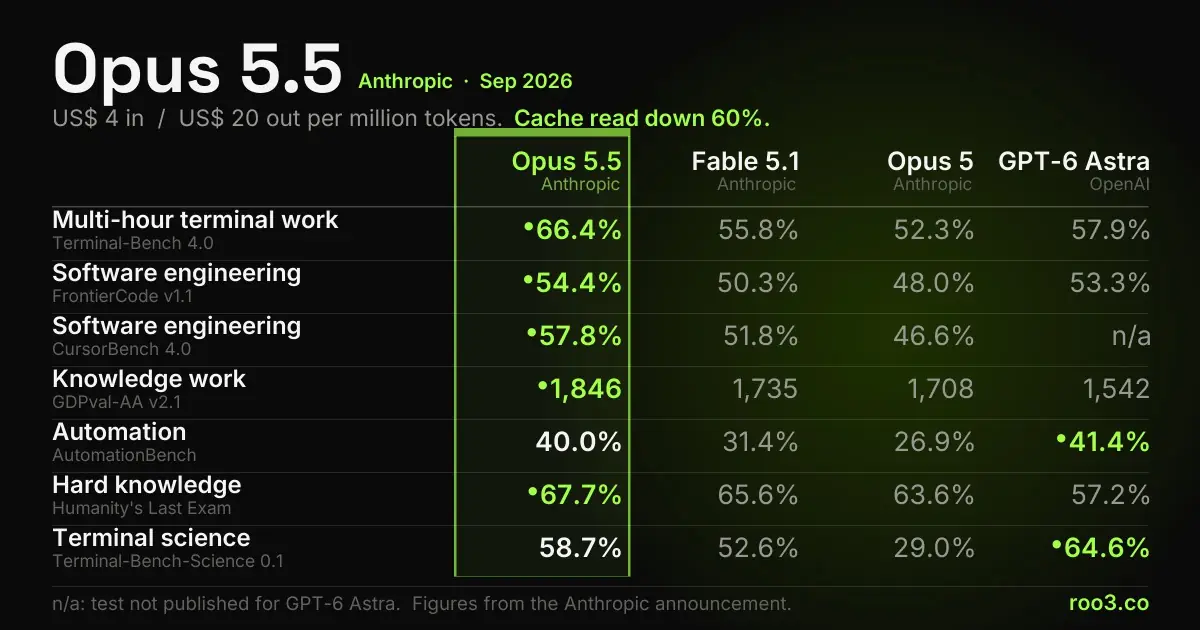
Opus 5.5: the expensive one got better and cheaper at once
Official Claude Opus 5.5 benchmarks against Fable 5.1, Opus 5 and GPT-6 Astra, the price per token, the 60% drop in...
11 min read
Muse, Meta's AI agent: what changes for anyone who sells online
What Meta launched at Connect 2026 around its Muse agent, why Amazon blocked Muse from shopping, how the stock reacted...
14 min read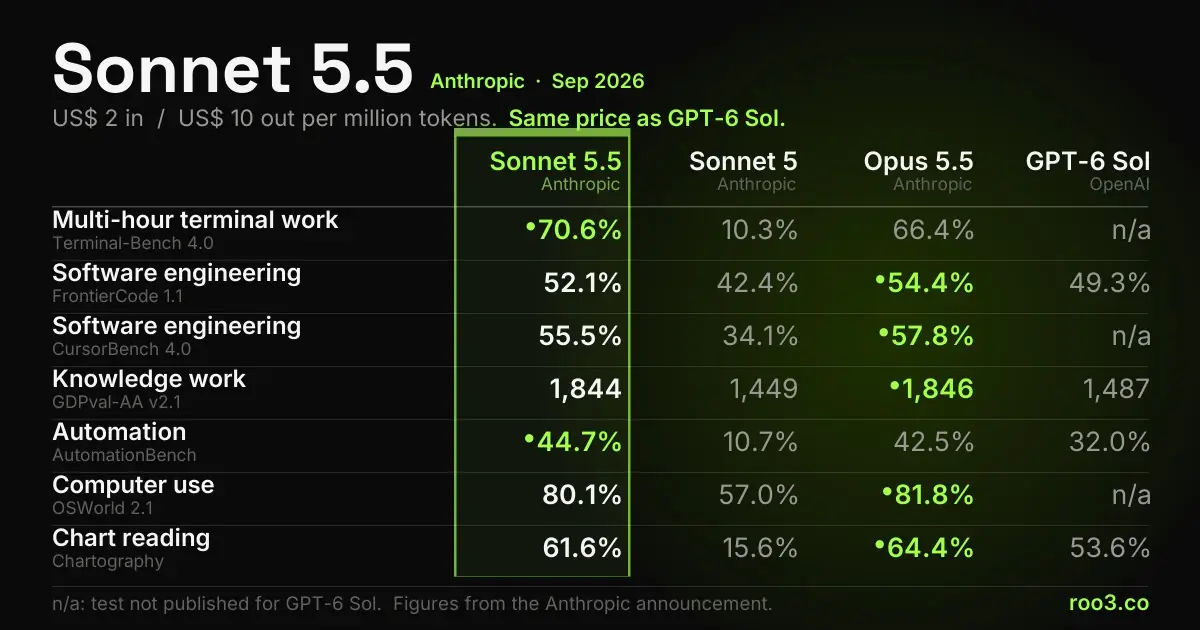
Sonnet 5.5: benchmarks, pricing and the real cost per task
Claude Sonnet 5.5 benchmarks against Opus 5.5, Sonnet 5 and GPT-6 Sol, a price identical to OpenAI's, and the effort...
16 min readWant to apply this in your company?
ROO3 diagnoses what can be automated first in your business. The first conversation is free.