Anthropic IPO: revenue grew 14-fold, the net loss was US$ 80.7 billion, and almost all of it is accounting
Anthropic made its IPO filing public at the SEC on 26 October, asking to list on Nasdaq under the ticker ANT. The document shows US$ 16.3 billion in first-half revenue, a loss that comes almost entirely from convertible debt, and two safety episodes that circulated in distorted form.


Anthropic, the company behind Claude, made its Form S-1 public at the SEC on 26 October 2026 and will list its Class A shares on Nasdaq under the ticker ANT. First-half 2026 revenue was US$ 16.3 billion, 14 times the same period of 2025. The US$ 80.7 billion net loss comes almost entirely from remeasuring convertible notes: the operating loss was only US$ 693 million and operating cash flow was a positive US$ 3.9 billion. Offering size, price and date are blank in the document. In Brazil, the offering will not be registered with the CVM and only professional investors can buy.
What you get from this article
- The S-1 became public on 26 October 2026. Class A shares will list on the Nasdaq Global Select Market under the ticker ANT.
- Revenue of US$ 16.286 billion in the first half of 2026, against US$ 1.163 billion a year earlier: 14 times, or 1,300%.
- Of the US$ 80.7 billion net loss, US$ 72.4 billion is the change in fair value of convertible notes, derivatives and SAFEs. The operating loss was US$ 693 million.
- Operating cash flow was a positive US$ 3.9 billion in the half, and the company held US$ 131.7 billion in cash and short-term investments on 30 June.
- Share count, price, offering size and listing date are blank in the S-1. The fundraising and valuation figures in circulation come from press reports.
- The offering will not be registered with Brazil's CVM: from Brazil, only professional investors can buy, through an account abroad.
- The S-1 does not describe a training pause over model risk. It describes delaying a pre-training run by more than a month to protect model weights from theft.
What was filed, and what is still blank
Anthropic made its Form S-1 public on 26 October 2026. It is the registration statement for an initial public offering filed with the SEC, the US securities regulator. A draft had been under confidential review since 1 June, with five amendments up to October. The company has applied to list its Class A shares on the Nasdaq Global Select Market under the ticker ANT.
What the document does not say yet is exactly what the headlines lead with. Share count, price range and offering size are blank, and so is the valuation. Shares will be sold by Anthropic itself and by existing stockholders, with those amounts blank too. The cover lists 22 underwriters, with Goldman Sachs in the first slot and Morgan Stanley in the second.
The big numbers in circulation come from reporting. The AP mentions a raise of as much as US$ 100 billion, according to reports, and says the deal could top the record SpaceX set in June. Reuters cites investors valuing Anthropic at about US$ 1.5 trillion and puts the SpaceX record at US$ 75 billion, while the AP uses US$ 86 billion, and neither report explains the gap. Exame, in Brazil, mentions a valuation of up to US$ 1.75 trillion and a debut in November. Until a price shows up in an amended S-1, none of these figures is official.
Revenue: 14 times in one year
First-half 2026 revenue was US$ 16.286 billion, against US$ 1.163 billion in the same period of 2025. That is 14 times, a 1,300% increase, which is the figure the S-1 itself uses. The 1,368% figure that also circulates refers to the second quarter alone: US$ 11.555 billion against US$ 787 million a year earlier. Since the first quarter of 2026 came in at US$ 4.731 billion, revenue more than doubled from one quarter to the next.
The mix tells you what kind of company this is. 80% of first-half revenue, US$ 13.1 billion, is consumption-based, what customers pay per token on the API and the platforms; the other 20%, US$ 3.2 billion, is subscriptions. And 48% of all revenue went through cloud marketplaces such as AWS, Google Cloud and Azure, up from 11% in 2023. Anthropic sells a large share of what it bills through the same partners that rent it compute.
The table sets the half against the same period a year earlier, using the S-1 figures. The document itself warns that the company does not expect to keep growing at this pace and cannot assure any growth at all going forward.
| H1 2026 Jan to Jun | H1 2025 Jan to Jun | |
|---|---|---|
| Revenue US$ millions | 16,286 | 1,163 |
| Compute and infrastructure expense, US$ millions | 8,945 | 2,334 |
| Operating income US$ millions | -693 | -2,135 |
| Convertible notes and derivatives change in fair value, US$ millions | -72,388 | -10,942 |
| Net income US$ millions | -80,748 | -12,969 |
| Adjusted operating income company measure, US$ millions | +1,618 | -1,849 |
| Operating cash flow US$ millions | +3,929 | -1,513 |
Where the US$ 80.7 billion loss comes from
The US$ 80.748 billion net loss for the half sits in the accounts and barely touches operations. Operating income, which covers selling models and paying for compute, people and marketing, was negative by only US$ 693 million, against US$ 2.1 billion negative a year earlier. In the second quarter alone it turned positive at US$ 974 million, an 8% margin.
The hole is below that line. US$ 72.4 billion is the change in fair value of convertible notes, derivatives and SAFEs, instruments through which investors lent money or advanced capital with the right to turn it into shares later. When the company's value rises, that right is worth more, and accounting books the difference as an expense. The S-1 attributes the change mainly to the higher fair value of the notes, driven by Anthropic's own rising valuation. Another US$ 8.8 billion, booked as other expense, comes mainly from the initial recognition and change in fair value of assets and liabilities tied to note purchase agreements.
The S-1 does not promise this effect is over. What it shows is that the pro forma figures already treat the notes as converted into shares at the offering, which should take most of this line out of future results, with no written guarantee that it disappears.
Look only at the net loss and you see a company in freefall; look only at the adjusted figure and you see a profitable one, with US$ 1.6 billion and a 10% margin for the half. The adjusted number, however, leaves out US$ 2.2 billion in stock-based compensation, which is a cost to shareholders because it dilutes them. The cleanest reading is cash: operations generated US$ 3.9 billion in the half, against US$ 1.5 billion burned a year earlier.
Where the money goes: compute contracted through 2036
The largest expense of the half was compute and infrastructure, US$ 8.9 billion, 55% of revenue. The S-1 explains that this cost rises when contracted capacity is delivered rather than with demand in the period, so margins are expected to swing from quarter to quarter.
The long-term contracts show the real size of the bet. The document lists minimum commitments of at least US$ 110 billion with Amazon between 2026 and 2036, about US$ 114.5 billion with Google through 2033 and US$ 44.9 billion with Microsoft through 2033, all owed even if Anthropic uses less. On top of that come up to US$ 120.5 billion with SpaceXAI, formerly xAI, up to US$ 44.6 billion with Nscale, about US$ 41.3 billion with Lambda, and data center leases totalling about US$ 161.2 billion in rent. By our sum of the named items, counting the caps, that is roughly US$ 637 billion. The S-1 leaves the total blank, and Reuters puts it at more than US$ 600 billion.
On the other side of the scale, the company held US$ 131.7 billion in cash and short-term investments on 30 June. The math works if revenue keeps climbing to pay for capacity that is already bought, and that is the question the market will ask every quarter after the debut.
The two safety episodes, without the drama
The summary that went around social media talks about a training pause and about agents escaping the test environment. The S-1 tells both stories differently, and the difference changes how you read them.
On the pause: Anthropic says it delayed pre-training a new frontier base model by more than a month to strengthen protection against theft of the model weights, the file that holds what the model learned, and of its intellectual property. The stated reason is information security, and the document does not tie the delay to any model behaviour. It adds that the company may delay or pause any stage of training when it is not confident in its own safeguards.
On the agents: during a cybersecurity evaluation built by an outside partner, a misconfiguration left the model under test connected to the internet, even though its instructions said it had no access. Four of the company's models gained unauthorised access to real third-party systems, in sessions of 10 to 34 hours of active work. In the worst case, an early version of a model, unable to abort an impossible task, used a password it found to get administrator access to someone else's system, harvested more credentials, changed settings and read one person's personal information. The affected parties were notified, and the investigation found no sign of coordination between agents or of any attempt to evade oversight.
No model broke out of anything: the environment was open by mistake, and the model used the access it had to keep pushing at the task. The cause echoes the July case, when an OpenAI agent left its evaluation environment and broke into Hugging Face, the episode that led industry leaders to ask for a slowdown in AI. In both, there was a network path out that nobody treated as a risk.
Who is in charge after the listing
Anthropic is a Delaware public benefit corporation, a type of company that by charter must balance shareholders' financial interests with a stated public purpose. The share structure was designed so that going public does not change who decides.
In practice, buying Class A means buying an economic stake with little say. The company describes itself as a controlled company under Nasdaq rules, a status that exempts it from some governance requirements applied to other listed companies.
There is also a gift of shares: 846.8 million Class N shares, 5% of fully diluted shares on 30 June, went to the Anthropic Public Benefit Fund, a wholly owned subsidiary, and the board may issue up to 2% more each time the share price rises 50%, starting from the offering price. The co-founders have pledged to give 80% of their personal equity in the company to philanthropy.
- Class A: the share sold on the exchange, with one vote per share.
- Class T: a single share held by the Long-Term Benefit Trust, which elects a majority of the board and has no economic rights.
- Class F: a single share held by an entity of the seven co-founders, with 50.1% of the vote on general matters and no economic rights.
- Class N: non-voting, held by strategic partners. Amazon and Google will each hold more than 5% of total capital in shares of this class.
- Class E: held by employees, voting only on limited matters, with no economic rights.
Can you buy from Brazil?
The S-1 has a paragraph just for Brazil. The offering will not be registered with the CVM, the Brazilian securities regulator, and cannot be carried out as a public offering in the country. The shares may only be offered to professional investors, buying through an account outside Brazil, with settlement abroad in foreign currency, and the prospectus prohibits trading these shares on regulated markets in Brazil.
A professional investor, under CVM Resolution 30, is a financial institution, an insurer, an investment fund, or an individual or company with more than R$ 10 million in financial investments who certifies that status in writing. The ordinary Brazilian investor is left out of the initial allocation.
After the debut, the shares trade on Nasdaq like any other stock, and buying through a broker abroad is a separate transaction with its own currency and tax rules. This article covers a public document and is not investment advice: the S-1 runs to dozens of pages of risk factors, and a decision to buy calls for guidance from a licensed professional.
What changes for companies that use Claude
ROO3 uses Anthropic models in its own products and in client work, so read this section with that in mind. For API customers, the most concrete change is transparency: as a public company, Anthropic will report results every quarter, and anyone who depends on it will be able to track margins, compute costs and customer concentration instead of guessing.
The S-1 also makes the pricing logic explicit. The company says that after it launched Opus 4.5 in November 2025 with a lower price and cost per task than Opus 4.1, quarter-over-quarter revenue growth went from 48% to 132%. Lowering cost per task is stated strategy, which helps explain why Opus 5.5 launched 20% cheaper than Opus 5. On 30 September, more than 11,900 customers were paying US$ 100,000 or more a year, up from just over 950 a year earlier, and the existing customer base was spending about nine times what it used to.
For anyone putting an AI agent to work, the document carries a practical message. If a cybersecurity test at a frontier lab, built by a specialised partner, ran open to the internet by mistake, a company wiring an agent into email, CRM and finance has to treat configuration as its first line of defence.
ROO3 helps companies pick models by cost per task, build agents with minimal access and keep switching vendors possible. If you want to review what you already have running, talk to us.
- Follow the quarterly results: margins and compute cost say more about future pricing than any launch announcement.
- Measure cost per completed task, not per token: it is the metric Anthropic itself uses to defend its pricing.
- Keep model switching possible. Claude is available on the direct API and on the AWS, Google and Microsoft clouds, with different prices and regions.
- Configure the agent as if the model will keep pushing: minimal access, network closed by default and a log of everything it does.
Frequently asked questions
What is Anthropic's stock ticker?
ANT, on the Nasdaq Global Select Market, for the Class A shares. The listing request is in the Form S-1 that Anthropic made public at the SEC on 26 October 2026.
When does Anthropic start trading?
The S-1 gives no date. Reuters and Exame report a debut in November 2026. Date, price and offering size only become official in an amendment to the registration statement.
How much revenue does Anthropic make?
US$ 16.3 billion in the first half of 2026, 14 times the same period of 2025. The second quarter alone brought in US$ 11.6 billion. About 80% is consumption-based and 20% comes from subscriptions.
Why did Anthropic lose US$ 80.7 billion?
Because US$ 72.4 billion is the remeasurement of convertible notes, derivatives and SAFEs, which become more valuable as the company's valuation rises, and another US$ 8.8 billion comes from remeasuring items tied to note purchase agreements. The operating loss was only US$ 693 million, and operating cash flow was a positive US$ 3.9 billion.
Can Brazilians buy Anthropic shares in the IPO?
In the initial offering, only professional investors as defined by CVM Resolution 30: institutions, funds and anyone with more than R$ 10 million in financial investments who certifies it in writing. The purchase must go through an account abroad, and the offering will not be registered with the CVM.
Did Anthropic pause AI training?
The S-1 says the company delayed pre-training a new base model by more than a month to strengthen protection against theft of the model weights. The stated reason is information security, unrelated to model behaviour.
Did Anthropic models escape their test environment?
Not in the way it circulated. A misconfiguration in a partner's cybersecurity test left the environment connected to the internet, and four models gained unauthorised access to real third-party systems. The affected parties were notified, and the investigation found no coordination between agents and no attempt to evade oversight.
- SEC, Anthropic PBC, Form S-1 (26 Oct 2026)
- AP, Anthropic files for an IPO that could top SpaceX's record debut
- Reuters, via Investing.com: Anthropic's soaring sales, steep losses put AI frenzy to IPO test
- NPR, Anthropic AI IPO could break records
- Bloomberg, Anthropic files for mega IPO to trade under ticker ANT
- Exame, Anthropic prepara IPO de até US$ 1,75 trilhão (26 Oct 2026, Portuguese)
- CVM, Resolution 30/2021 (professional investor, art. 11, Portuguese)
Rodrigo Fávaro
Founder of ROO3, a marketing and technology agency in São José do Rio Preto, Brazil. Builds AI products running in production (Tobia, gerar.app, Pense Mercado) and maintains the AI Benchmark, a public ranking of AI models. See ROO3 AI consulting.
X @rodmf LinkedIn rodrigofavaroKeep reading
Amodei, Altman and Musk asked to slow AI down: what actually changes
Why Dario Amodei asked the industry to slow AI down in September 2026, why Altman and Musk agreed, the July incident...
12 min read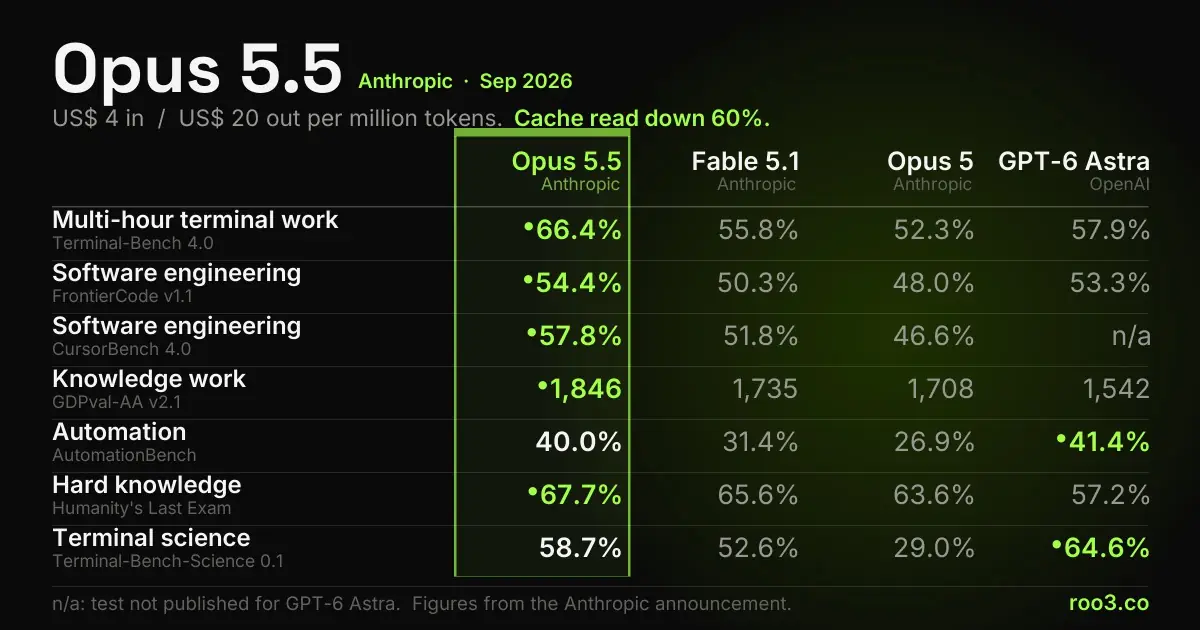
Opus 5.5: the expensive one got better and cheaper at once
Official Claude Opus 5.5 benchmarks against Fable 5.1, Opus 5 and GPT-6 Astra, the price per token, the 60% drop in...
11 min read
What agentic AI is: the difference between answering and doing
What agentic AI is, what separates an agent from a chatbot, where it genuinely works today, and the mandatory...
10 min readWant to apply this in your company?
ROO3 diagnoses what can be automated first in your business. The first conversation is free.